

Did you know: if you invested ₹1 lakh in the Nifty 100 TRI back in 2003, it would be worth roughly ₹34.46 lakh by June 2026, at almost 16.2% CAGR over more than two decades. But that number hides the investment journey: a 61% crash during the 2008 financial crisis, a 38% fall during the 2020 Covid crash, and four other double-digit drawdowns along the way.*
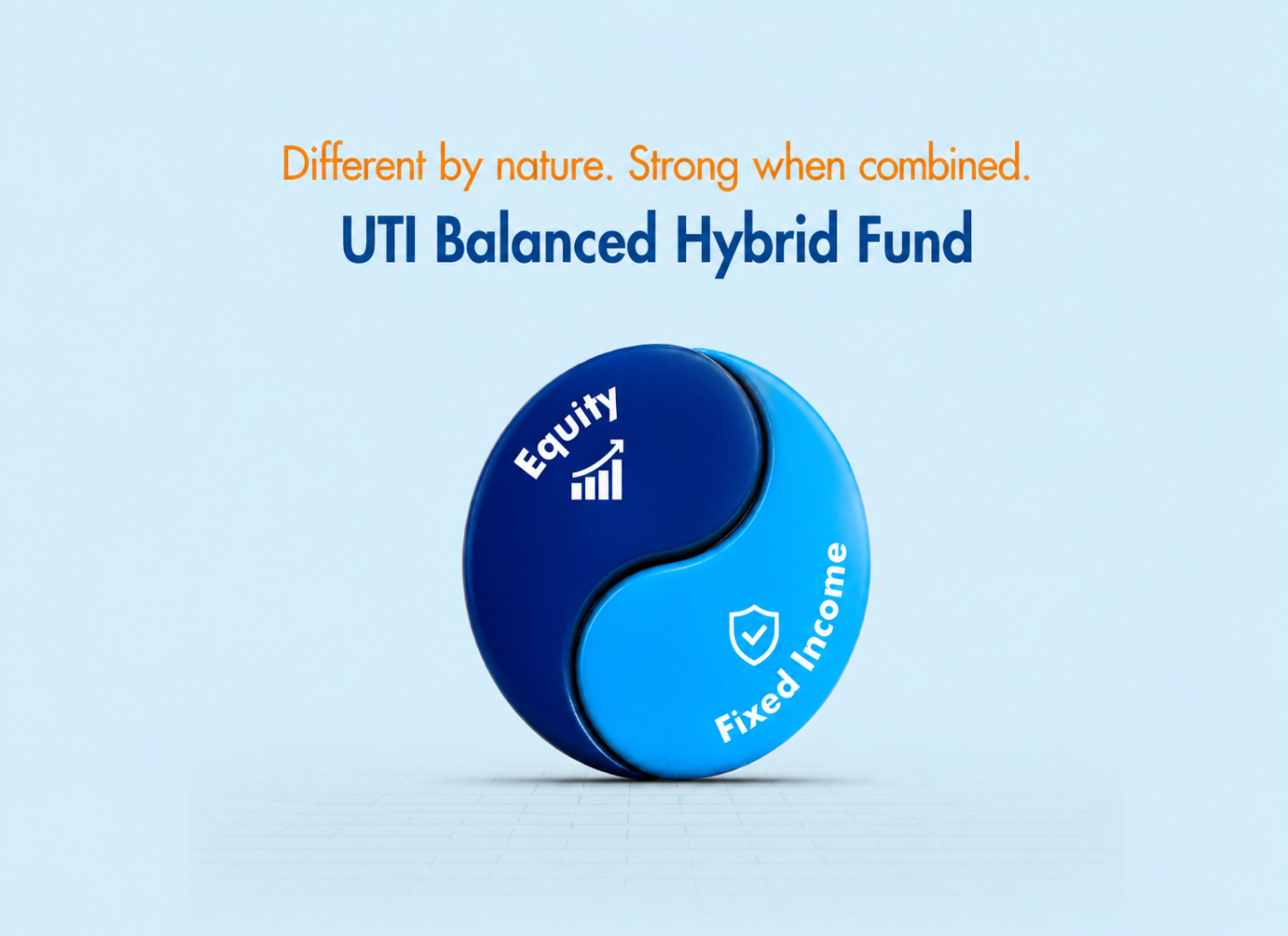
That's the tension every equity investor eventually faces because wealth creation and volatility are usually a package deal. UTI Mutual Fund's new offering, the UTI Balanced Hybrid Fund, is built around that exact tension––pairing equity's growth potential with a substantial allocation to fixed income in one disciplined portfolio.
The NFO runs from August 14 to 28, 2026. Here's what you need to know about the UTI Balanced Hybrid Fund.
What is a Balanced Hybrid Fund
It's a SEBI-defined category that has to hold 40-60% of the portfolio in equity and 40-60% in debt and money market instruments. Arbitrage is not permitted in the category. The scheme may also allows up to 10% in REITs and InvITs for additional real-asset exposure, sitting alongside the core equity-debt split.
Why investors struggle to stay invested
Markets tend to move through emotional cycles: optimism and excitement on the way up, giving way to euphoria and greed near the top, then anxiety, fear and panic on the way down. A Morningstar "Mind the Gap" study using data through June 2022 found this cycle has a real cost.
Over a 10-year period, the average investor earned 9.53% CAGR against the 12.33% actually delivered by the underlying investments, a gap that turns a ₹1 crore investment worth ₹3.20 crore on paper into just ₹2.49 crore in an investor's account. The substantial ₹71 lakh difference illustrates the potential effect of investor cash-flow timing and behaviour.
Why not just pick one asset class
Pure equity, represented here by the Nifty 100 TRI, delivered a 12.5% CAGR over 20 years but with 20.9% annualised volatility. Pure fixed income, tracked through the CRISIL Short Term Bond Fund Index, delivered a steadier 7.2% CAGR with only 3.2% volatility and hasn't posted a single negative year in two decades.
In UTI's historical analysis, the 50:50 combination sacrificed some of equity's return potential in exchange for substantially lower volatility, while delivering higher long-term returns than the fixed-income proxy at correspondingly higher risk. Equity markets offer long-term wealth creation potential, while fixed income offers relatively stable income potential.
Finding the balance point
Looking at different equity-to-fixed-income mixes, from 80:20 down to 20:80 over a 20-year stretch, UTI's asset-mix illustration shows:
An equal 50:50 split has delivered 10.1% returns at 11.4% risk, which UTI's analysis identifies as the “sweet spot”.
In a separate trailing-period analysis covering 1, 3, 5, 10 and 20-year periods, a 50:50 portfolio's risk-adjusted returns improved by close to 62% compared to pure equity, volatility dropped by about 47%, and the hit to raw returns was only around 15%.
That holds up on a rolling basis too, both 3-year and 5-year rolling windows since 2006 show the balanced mix improving risk-adjusted returns by 55–58%.
How the fund keeps that balance
The equity allocation isn't fixed at exactly 50%; it moves within the 40-60% band depending on valuations. When valuations appear expensive, the fund can reduce equity exposure towards the lower end of the permitted range, potentially moderating portfolio volatility. In normal conditions, it aims to maintain an allocation of 50% to equities. When valuations look attractive, equity exposure can move towards the upper end of the band.
This rebalancing discipline is essentially meant to do the emotional work of buying low and trimming high on your behalf.
The equity sleeve
UTI's stated equity framework looks for a blend of growth and value, targeting companies with mid-to-high teens earnings growth at reasonable PEG-based valuations and strong incremental return on capital employed.
The proposed portfolio is expected to be market cap and sector agnostic, potentially holding 50 to 60 high-conviction stocks across large, mid and small caps, with a tilt toward structural themes like manufacturing and import substitution, export-led businesses, digital and new-age opportunities, power and infrastructure, and premium discretionary consumption. Stock, sector, liquidity and factor risk limits keep any single conviction call from dominating the book.
The fixed income sleeve
On the debt side, the fund runs an actively managed duration strategy within a 3–7-year intermediate band, focusing predominantly on sovereign, AAA and equivalent-rated issuers for quality and liquidity.
As of June 2026, UTI deems that segment to be attractive given a neutral RBI stance, comfortable liquidity from FCNR and ECB inflows, a recovering monsoon, and a resilient growth outlook, a backdrop UTI frames as offering the better risk-adjusted opportunity compared to shorter or longer duration bonds.
Key terms to know
You can invest with a minimum of ₹1,000, in multiples of ₹1 thereafter, through Regular or Direct plans under Growth or IDCW options. There's no exit load if you redeem after 12 months, or on up to 10% of your units within 12 months, but a 1% exit load applies beyond that within the first year. The fund benchmarks against the NIFTY 50 Hybrid Composite Debt 50:50 Index, and its risk-o-meter currently reads "High".
Who's managing it
Ajay Tyagi, UTI MF's Head of Equities with 26 years at UTI MF, and Kamal Gada, with 18 years of experience in equity research, run the equity sleeve, while Anurag Mittal, Head of Fixed Income with total work experience of 20 years and previous roles in IDFC, HDFC and Axis AMC, manages the debt portion. They're backed by a 28-member equity team and a 10-member fixed income team at UTI MF.
The core idea is not about choosing equity over debt, but about combining the two within a disciplined allocation framework. Historical data also indicate that investor behaviour during periods of volatility can materially influence the returns ultimately experienced. As always, read the scheme information document and check whether the risk profile suits you before the NFO closes on 28th August.
*Source: MFI Explorer & Nifty Indices Limited. Reference: Nifty 100 TRI. Data as of June 2026. Past performance may or may not be sustained in future and is not a guarantee of any future returns. The figures pertain to performance of the index and do not indicate the returns/performance of the scheme.
UTI BALANCED HYBRID FUND
(An open ended balanced scheme investing only in equity and debt instruments.)
No arbitrage is permitted in the scheme
This product is suitable for investors who are seeking*:
- Long term capital appreciation
- Investment in equity and equity related instruments and fixed income securities
*Investors should consult their financial advisers if in doubt about whether the product is suitable for them
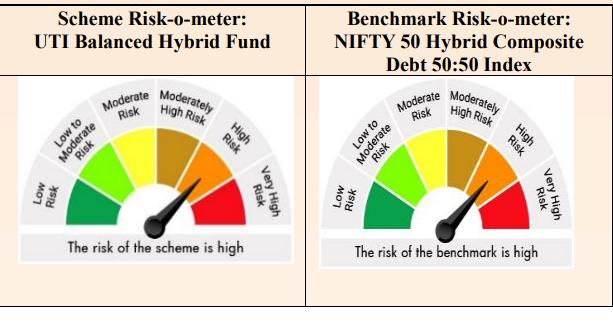
Product labelling assigned during the New Fund Offer (NFO) is based on internal assessment of the scheme characteristics or model portfolio and the same may vary post NFO when the actual investments are made.
Mutual Fund investments are subject to market risks, read all scheme related documents carefully.