


Many new investors in India are aware of the Nifty 50, the index that shows up on every trading app's home screen. But the Nifty 50 represents only about 53% of the free-float market capitalisation of NSE-listed companies. Few are aware about Nifty 500, which expands the scope substantially, covering about 90% on the same basis (as on 31st July 2026).
What is the Nifty 500 index?
The Nifty 500, a product of NSE Indices Limited, is an index that tracks the top 500 companies listed on the National Stock Exchange (NSE) by full market capitalisation and average daily turnover. Unlike the Nifty 50, which sticks to large caps, it includes large, mid and small caps together, covering roughly 90% of the free-float market capitalisation of NSE-listed stocks, across 20 sectors.
For comparison, the S&P 500 in the US covers about 80% of US market cap across just 11 sectors and is entirely large cap. The Nifty 500 therefore offers broader market coverage than a large cap-only benchmark.
What is a Nifty 500 index fund?
A Nifty 500 index fund is a passively managed mutual fund that aims to mirror the Nifty 500 Total Returns Index (TRI). It predominantly holds the same stocks in broadly the same proportion as the index, and its objective is to deliver returns that correspond to the Nifty 500 TRI before expenses, subject to tracking error.
The fund manager does not analyse which sector will outperform next quarter. Instead, they focus primarily on replicating the index as closely as possible, which keeps costs relatively low and takes active stock selection out of the equation.
How the index is built
The construction rules are transparent. A stock needs a minimum one-month listing history on the NSE, and it has to clear a liquidity filter, trading on more than 90% of days over the last six months while ranking among the top 800 stocks by average daily turnover and average market cap.
The Top 500 are picked by six-month average full market cap, weighted by free-float market cap, and the index rebalances twice a year, in March and September, so it keeps reflecting who's actually leading the market.
Where the money actually sits
By market cap, roughly 68% of the Nifty 500's weight comes from Nifty 100 stocks, 21% from Nifty Midcap 150, and 11% from Nifty Smallcap 250.
Financial Services is the biggest sector at around 31% as of July 2026, followed by Automobile at 7.5%, Healthcare at 7.3%, Capital Goods and Oil & Gas at 7% each, and IT at 6.4%.
What's telling is the long tail: Chemicals, Realty, Textiles and Media all feature here, sectors that are not present in the Nifty 50 Index composition. The top 30 stocks make up about 47% of the index, the next 20 add another 10%, and the remaining roughly 450 companies account for the other 43%.
(As of July 31, 2026)
Why investors are drawn to this fund
Market leadership is constantly evolving. Looking at yearly data from FY16 through FYTD27, leadership has rotated repeatedly between large, mid and small caps, with mid and small caps topping the charts in 5 of the last 12 financial years each, against large caps leading in just 2.
A fund built only on large caps can miss those windows, and a passive fund tracking a broad index is also generally more cost-effective than an actively managed one. The historical numbers back the broader approach too. Nifty 500 TRI has delivered better Annualized Returns and Risk Adjusted Returns than Nifty 50 TRI and SENSEX TRI across periods.
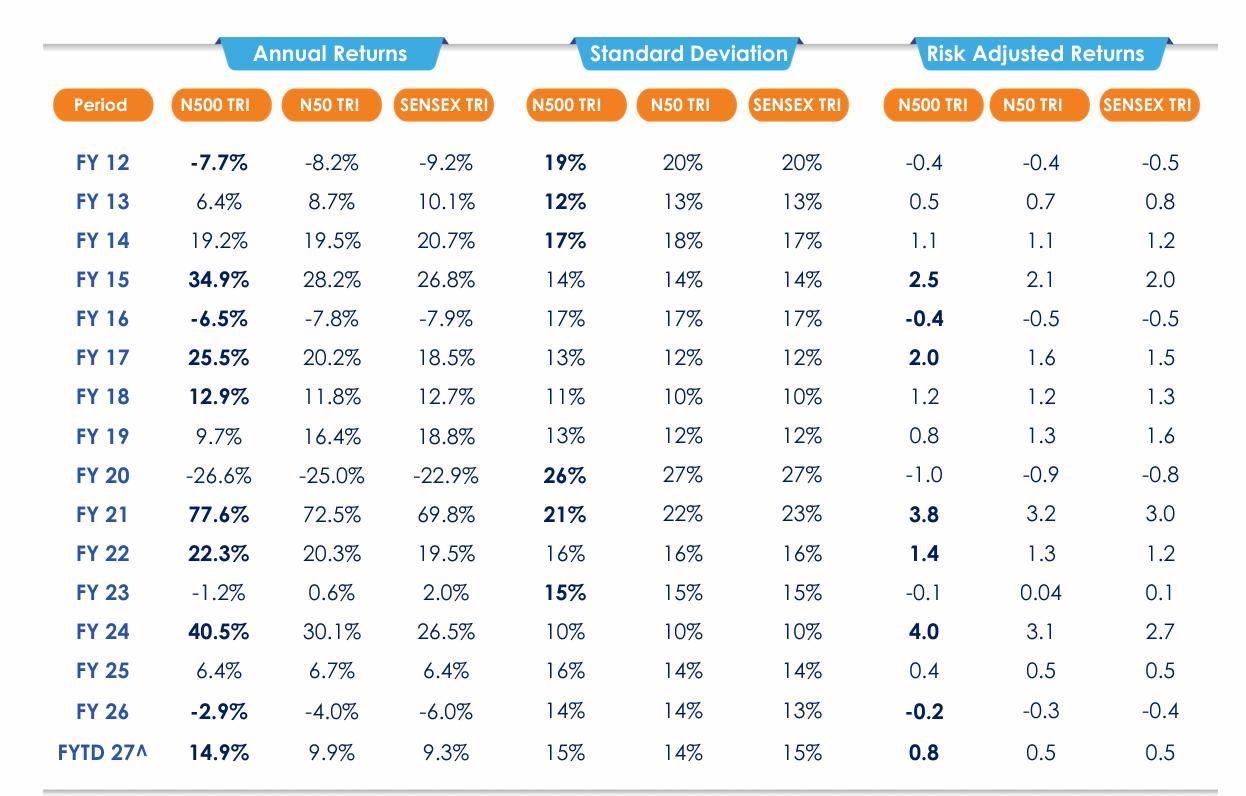
Over the last 15 FYs, N500 has demonstrated:
• Returns in 10 instances vis-à-vis N50 TRI & 9 instances vis-à-vis SENSEX
• Volatility in 6 instances vis-à vis N50 TRI and SENSEX TRI
• RAR* in 8 instances vis-à-vis N50 TRI & 7 instances vis- à -vis SENSEX TRI
‘N500’: Nifty 500 TRI, ‘N50’: Nifty 50 TRI, ‘SENSEX’: BSE SENSEX TRI
Source : MFI, based on Total Returns Index. ^FYTD27 Period – April 01,2026 to July 31, 2026. Past performance may or may not be sustained in the future and shall not be used for comparison with other investments. The figures pertain to performance of the index and do not indicate the returns/performance of the scheme. It is not possible to invest directly in Index. *RAR – Risk Adjusted Returns
How you'd actually invest
UTI Mutual Fund has launched a new fund offer – UTI Nifty 500 Index Fund – which is open from August 10th to August 24th 2026. UTI MF has a track record of over two decades in offering passive investment strategies, with an AUM of roughly ₹1,90,541 crores across 31 passive funds as of July 2026.
-
With UTI Nifty 500 Index Fund , you can start with as little as ₹1,000, with subsequent additions in multiples of ₹1 and no upper limit.
-
SIPs start at ₹500 for daily, weekly or monthly frequency, and ₹1,500 for quarterly SIPs.
-
There's no entry load, and no lock-in period, so your money remains liquid.
-
You can invest through the UTI Mutual Fund website or app, a SEBI-registered distributor, or other permitted platforms, choosing between the Regular and Direct plan, both under the Growth option.
The risks worth knowing
Being an equity fund , it carries market risk, so your investment value will fluctuate in line with the broader market, sometimes sharply, especially over the short term. There's tracking error risk too, since returns can drift from the index due to expenses, cash holdings or corporate actions. There is also liquidity risk in the underlying securities and general economic and regulatory risk. The scheme's risk-o-meter classifies it as "Very High Risk" so it is important to gauge your risk tolerance before considering an investment.
A final word
A Nifty 500 index fund broadens exposure beyond a large caps by adding companies from the mid and small cap universe. You're still holding those same 50 market leaders, just alongside roughly 450 other companies that make up the rest of India's investable market. However, as with any equity investment, read the scheme documents and talk to a financial advisor to see if it fits your goals and risk appetite.
Disclaimer:
The sector(s)/stock(s)/issuer(s) mentioned above do not constitute any research report/recommendation and the schemes may or may not have any future position in these sector(s)/stock(s)/issuer(s)
Mutual Fund investments are subject to market risks, read all scheme related documents carefully.