
Lessons from three decades of market cycles
 5 min
During bullish markets, ask any investor about their time horizon, and the answer would almost inevitably be: “I am a long-term investor!”
While that is certainly the right attitude, most investors may not be fully aware of what this entails. Bull markets often lull investors into believing that returns can be generated year after year and that market corrections last only a few quarters or a couple of years before new highs are made. However, history shows that there are times when returns can remain subpar for an extended period.
While the Indian economy has witnessed strong economic growth over the past three decades, leading to strong earnings growth, there have also been phases of weak market returns. This has been evident even over medium to long-term periods, such as five or ten years. Historically, Indian markets have delivered long-term returns of around 13-14%, in line with earnings growth of about 12% and a dividend yield of about 1.5%. However, there have been periods when ten-year returns have fallen a few percentage points below these average levels.
Markets are driven by multiple factors and there is never a single one that drives them. However, if starting valuations are high, then ceteris paribus, future returns over the medium to long-term usually undershoot expectations.
Let us look at how the markets have behaved over the past three decades, particularly during periods when valuations were significantly higher than long-term averages.
Market manipulation by Harshad Mehta:

The five-year and ten-year returns from January 1, 1992, were 10.8% and 6.2% for the BSE Sensex, respectively. Interestingly, between January 1, 1992, and April 22, 1992, the markets more than doubled, reaching extremely high valuation levels. This period is often referred to as the ‘Harshad Mehta Scam’ phase. From the peak of this phase (April 22, 1992), the subsequent five-year and ten-year BSE Sensex returns were -3.0% and -1.7%, respectively.
Post-Liberalisation period:

While the markets corrected from these heady levels of April 1992, they once again rallied in 1994, though valuations this time were not as extreme as in 1992. Still, from January 1, 1994 (by the way, the markets went up another 30% before peaking in September 1994), the five-year and ten-year BSE Sensex returns were -1.7% and 7.0%, respectively.
Pre-Global Financial Crisis period:

Now let’s consider the bull run that took place between 2003 and 2008. For this period, data is also available for the Midcap Index. The markets peaked in early 2008, at which point valuations were clearly higher than long-term averages. The BSE Sensex delivered returns of 0.7% and 6.8% over the next five years and ten years, respectively. From these levels, the Nifty Midcap 150 Index returned -2.0% over the next five years and 10.1% over the next ten years.
Even if we consider returns from January 1, 2007, when the markets were about 30% below the peak reached in January 2008, the BSE Sensex delivered returns of 3.5% and 8.2% over the next five years and ten years, respectively. The Nifty Midcap 150, from January 1, 2007, delivered returns of 1.7% and 11.7% over the next five and ten years respectively.
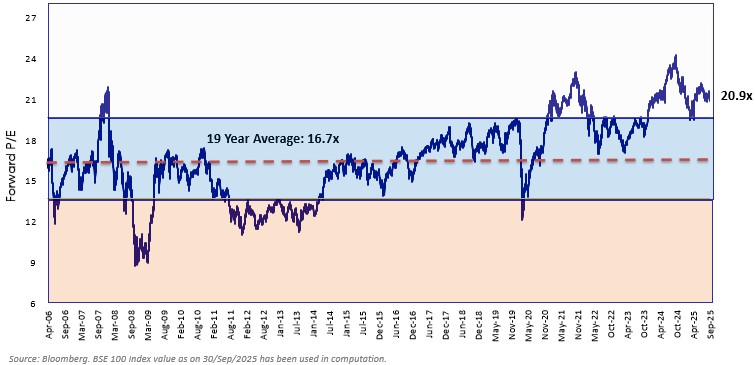
Now let’s look at the current valuations of the markets. As is evident, while both large caps as well as midcaps appear overvalued, the extent of overvaluation in midcaps is particularly alarming.
Valuation – BSE 100 Forward P/E (Rolling 1-year forward)
Valuation – Nifty Midcap 100 Forward P/E (Rolling 1-year forward)
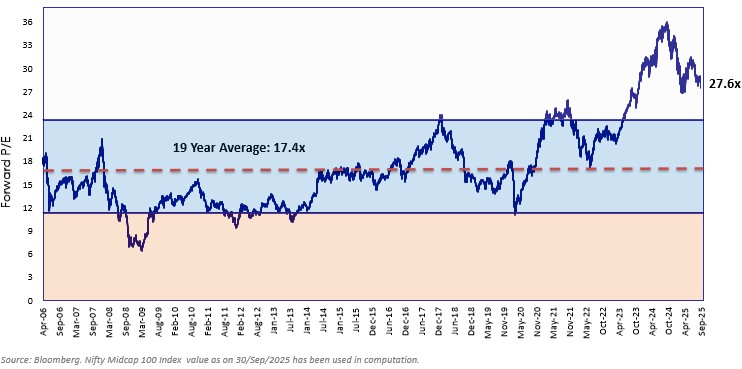
While it is impossible to predict future returns by any means, reversion to the mean is an undeniable fact of financial markets. Even though the Indian economy is likely to continue performing well over the coming decade, current valuations suggest that returns over the next five and ten years may not be as strong as those of the previous five and ten years.
After reading the above, one may feel that this is not an appropriate time for investing in equities. However, the intent of this blog is not to discourage investors from doing so. For all we know, equities may still be the best-performing asset class over the next ten years. The purpose is to remind investors to temper their return expectations and recognise that the strong returns of the past five years may have borrowed a few percentage points from the future, which means future returns are likely to reflect this phenomenon.
Keeping this in mind, the ideal approach to investing in equities in the current scenario would be to stagger investments through STPs or SIPs over the next few quarters. Moreover, on account of rich valuations investors may look to invest in large cap-oriented funds over mid and small cap funds.
Finally, in the words of prominent American philanthropist and former investor Shelby M.C. Davis, “Invest for the long haul. Don’t get too greedy and don’t get too scared.”
The views expressed are the author’s own views and not necessarily those of UTI Asset Management Company Limited. The views are not investment advice and investors should obtain their own independent advice before taking a decision to invest in any asset class or instrument.
Mutual Fund Investments are subject to market risks, read all scheme related documents carefully.

Discover more topics
Don't miss any update
Be the first to get exclusive offers, articles and news on our product directly in your inbox.


