
Look Before Leap: Update on the Monetary Policy
 5 min
5 min Rate Action: The Monetary Policy Committee (MPC) today (February 8) voted 4-2 (from the previous 5-1) to raise the policy repo rate by 25 bps to 6.50%, largely in line with consensus expectations. The external members Prof. Jayanth Varma and Dr. Ashima Goyal dissented against the decision and voted against the rate hike. The policy corridor floor, the Standing Deposit Facility (SDF) rate was also hiked by 25 bps to 6.25%, while the ceiling Marginal Standing Facility (MSF) rate was hiked to 6.75%.
With today’s rate hike, the repo rate has now been increased by a cumulative 250bps since April 2022, while the effective policy rate has undergone an increase of 315bps (the banking system was at lower bound of the policy rate corridor of 3.35%).
Monetary Policy Stance
The market participants were expecting a change in the policy stance to “neutral”, given the reduction in global inflation expectations. However, they were disappointed with the continuation of the “withdrawal of accommodation” stance.
In the previous policy, external MPC members Dr. Ashima Goyal & Prof. Jayanth Varma had argued in favour of change in stance to neutral. Dr Goyal had cited significantly lower liquidity compared to the pandemic era as justification for a neutral stance, while Prof. Varma had supported his view on account of reduced inflation expectations and strong growth concerns.
While both the members continued to vote against the current stance, the majority of the MPC members voted to maintain the stance of “withdrawal of accommodation”. The MPC members remained concerned on inflation, although the Governor, acknowledged that the worst in inflation is over. Even though the MPC expects risks to inflation as “mixed”, both the Governor’s statement and the MPC’s resolution cited the need to break the persistence of core inflation. There were concerns due to risks from supply disruptions owing to geopolitical tensions, risks from adverse weather events and the ongoing pass-through of input costs to output prices, especially in services.
The MPC noted the following on inflation:
“The easing of inflation in the last two months was driven by strong deflation in vegetables, which may dissipate with the summer season uptick. Inflation, therefore, remains a major risk to the outlook. Headline inflation excluding vegetables has been rising well above the upper tolerance band and may remain elevated, especially with high core inflation pressures”.
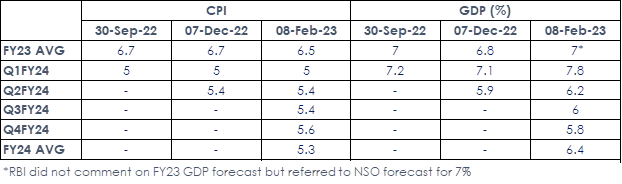
Below are the key RBI estimates on the evolution of growth/inflation trajectory into the next year compared to their previous forecasts:
Assessment of Inflation
With inflation averaging 6.12% in Q3FY23 versus the RBI’s estimate of 6.6%, the RBI downwardly revised its forecast for FY23 of 6.7% to 6.5%.
The RBI retained its 1HFY24 forecasts on inflation. It is projecting inflation of 5.4% for Q3 FY24 (Sep-Dec) and 5.6% for Q4FY24 (Jan-March). The RBI revised its crude assumption from previous policy of USD100/bbl to USD95/bbl.
Assessment of Growth
The RBI is optimistic on growth for FY24 with the prospects of a good Rabi harvest, a rebound in contact intensive services, a broad-based credit growth, the government’ capex and improving consumer confidence and has projected 6.4% real GDP growth for FY24.
Forward Guidance
Dr. Patra, Deputy Governor, RBI, alluded to RBI’s Q4FY24 projection of 5.6% as a benchmark for calculation of its real rate of 90bps.
A change of stance would have given market participants an indication that interest rates hikes were over but would have left the RBI vulnerable for more aggressive rate actions in future if inflation failed to moderate. We believe the RBI was sensible in not calling the peak in rates and in avoiding giving validation to market participants that inflation has moderated sufficiently.
Liquidity
The RBI noted that overall liquidity remains in surplus and the expected government spending and FX inflow-related increase in liquidity could be mitigated from LTRO (Long Term Repo Operations) and TLTRO (Targeted Long Term Repo Operations) maturities during February to April, 2023. The RBI Governor reiterated his December 2022 policy stance that the RBI will be ready to conduct operations on either side of the LAF, depending on the evolving liquidity conditions.
Outlook: Portfolios with Moderate Duration** preferable in a ‘Higher for Longer’ Regime
We are not overtly concerned with the extremely cautious language in today’s policy. Given that inflation has comfortably moved below the upper end of RBI’s comfort band of 6% and is expected to remain lower, the economy does not need aggressive rate actions unlike the advanced economy central banks. Nudging headline inflation close to RBI’s target could be better achieved by maintaining real rates for an extended period rather than aggressive rate hikes. In essence, the bar is now high for the RBI to hike in the next policy and will require significant shift in inflation and external stability expectations.
In recent months, there has been a tug-of-war between central banks and market participants, wherein market participants have attempted to position for preemptive peak in the cycle while central banks have preferred to wait for actual data points. This has resulted in high market disruptions and volatility.
Barring exceptional shocks, current valuations are attractive on real basis and reflect the convergence between the expected central bank policy path and market participants. However, the money market curve could remain volatile in the near term due to the usual quarter ending liquidity and balance sheet pressures.
Given the significant correction on the short-end of the yield curve, investors with 6-12 months horizon may consider an allocation to low duration/ money market strategies, while investors with more than three-year investment horizon may consider staggered allocation towards roll-down strategies and actively managed duration categories.
20230208-123958.png)
** (1-4 years)
Product Labelling and Riskometer
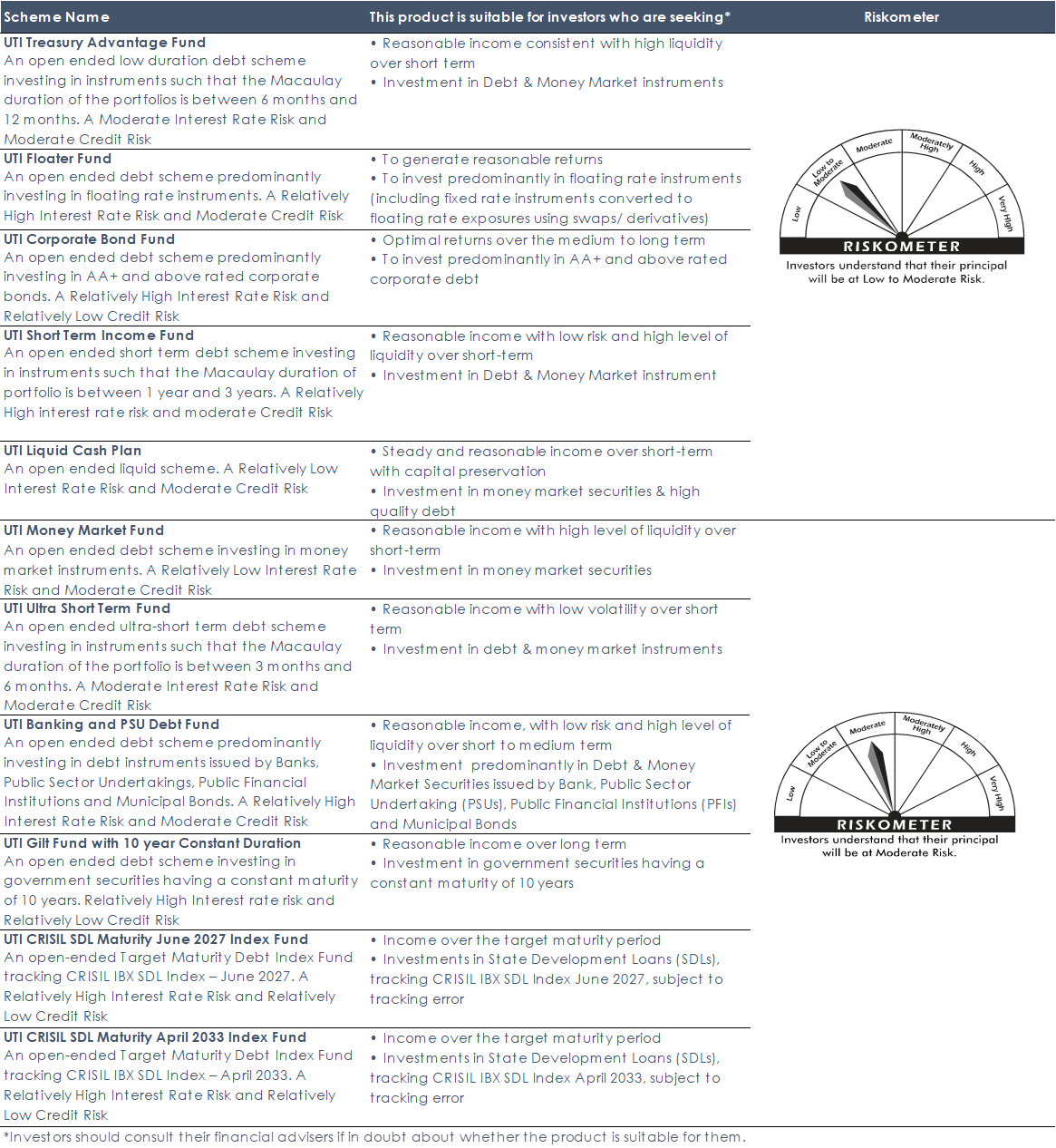
#Risk-o-meter for the fund is based on the portfolio ending January 31, 2023. The Risk-o-meter of the fund/s is/are evaluated on monthly basis and any changes to Risk-o-meter are disclosed vide addendum on monthly basis, to view the latest addendum on Risk-o-meter, please visit the addenda section on https://investor.utimf.com/forms-and-downloads
Potential Risk Class Matrix
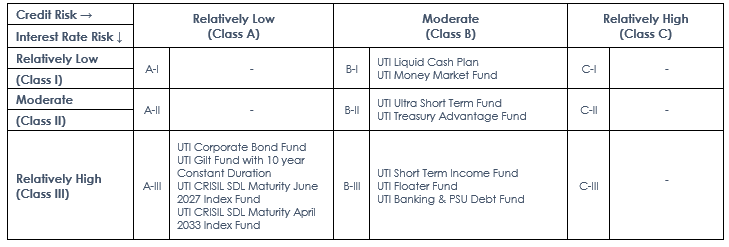
Mutual Fund Investments are subject to market risks, read all scheme related documents carefully.

Discover more topics
Don't miss any update
Be the first to get exclusive offers, articles and news on our product directly in your inbox.


