
Money Market Funds: A Smarter Alternative in a Surplus Liquidity Regime
 4 min
Liquid Funds have long been a cornerstone of short-term investment strategies. Their ability to offer high liquidity, low volatility and minimal credit risk makes them ideal for parking surplus cash and meeting near-term financial goals.
The Emerging Challenge: Falling Returns in Liquid Funds
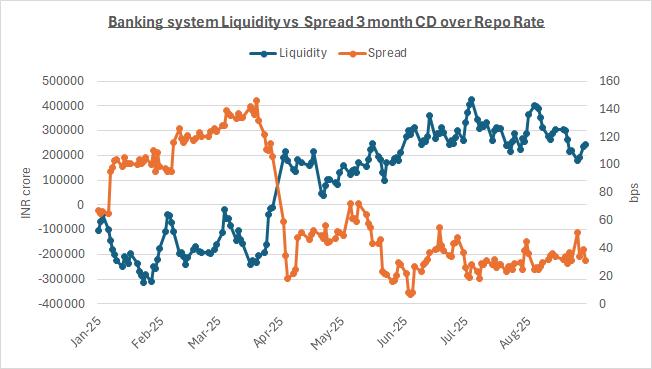
In recent months, investors have faced a new challenge: declining returns from Liquid Funds. This trend, largely driven by surplus liquidity in the banking system, has compressed the spread between three-month Certificates of Deposit (CDs) and the repo rate. The three-month CD rate serves as a benchmark for the money market segment, as yields on other short-term instruments tend to align closely with it.
The chart below illustrates how surplus liquidity has compressed the three-month CD spread over the repo rate.
Why Money Market Funds Are Gaining Traction
Currently, the yield differential between Money Market Funds (MMFs) and Liquid Funds is meaningful. With stable policy rates and surplus liquidity anchoring short-end volatility, the marginal extension in duration enhances portfolio carry while preserving the core objectives of safety and liquidity.
When it comes to credit risk, MMFs generally carry a similar risk profile to Liquid Funds. Most fund houses maintain comparable portfolios, investing in high-quality instruments such as treasury bills, commercial papers and certificates of deposit issued by top-rated entities.
This alignment in portfolio composition ensures that credit risk remains low across both categories, making MMFs a reliable option for investors seeking slightly better returns without compromising on safety.
Historical Performance Advantage
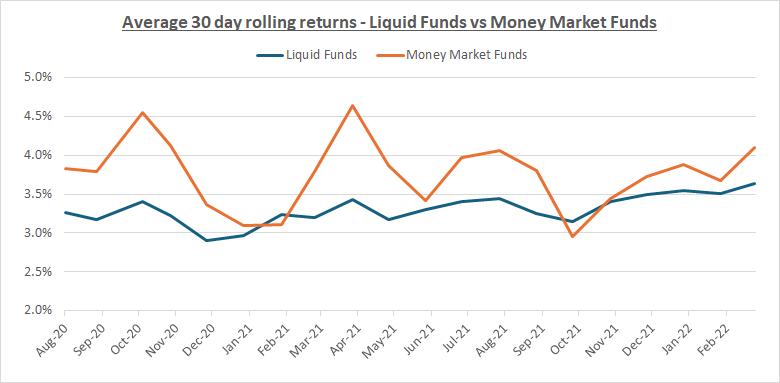
We are entering a "lower for longer" interest rate regime, similar to the period from August 2020 to March 2022, which was characterised by stable rates and surplus liquidity. Historically, such environments have favoured Money Market Funds (MMFs) over Liquid Funds. The former’s ability to lock in better yields, without significantly increasing credit risk, makes it a preferred choice for investors.
For a clearer picture, see the chart below, which compares the monthly average daily rolling performance of Liquid Funds and MMFs over the period from August 2020 to February 2022.
|
MMF vs Liquid Performance gap (Aug 20 to Feb 22) |
MMF outperformance (in bps) |
|
Average Spread |
45 |
|
Minimum Spread |
-20 |
|
Maximum Spread |
120 |
In a stable liquidity environment, MMFs have consistently outperformed Liquid Funds, delivering an average excess return of 45 basis points. This suggests MMFs are well placed to do the same in today’s environment.
Conclusion: Time to Reconsider Your Short-Term Strategy
While Liquid Funds remain a reliable and safe option, Money Market Funds can also offer reasonable return potential in the current environment. For those with a short-term horizon and a slightly higher risk appetite, MMFs present an attractive investment opportunity to enhance portfolio yield without compromising on safety.
As the market continues to navigate surplus liquidity and stable rates, MMFs are well-positioned to deliver relatively consistent and better performance, making them a smart choice for investors.
Here’s the kind of investor who may find MMFs most useful:
-
Investors aiming for returns moderately higher than liquid or overnight funds
-
Investors with an investment horizon of at least 30 days
-
Investors with an appetite for intermittent mark-to-market volatility
Within this category, UTI Money Market Fund (UTI MMF) stands out for its size, consistency and disciplined portfolio approach.
Here’s why investors choose UTI Money Market Fund:
-
Size: With an AUM exceeding ₹20,000 crore, the fund reflects strong investor confidence, driven by portfolio quality and consistent performance.
-
Consistency: The fund has a solid track record across both short-term and long-term horizons, consistently outperforming its benchmark over a 3-year period.
-
Portfolio Quality: UTI MMF adheres to an internal policy requiring at least 75% of the portfolio to be invested in long-term AAA-rated papers. This discipline has been maintained for more than three years, with any deviation rectified within 7 days.
Source: Bloomberg, MFI
The views expressed are the author’s own views and not necessarily those of UTI Asset Management Company Limited. The views are not investment advice and investors should obtain their own independent advice before taking a decision to invest in any asset class or instrument
Mutual Fund Investments are subject to market risks, read all scheme related documents carefully.

Discover more topics
Don't miss any update
Be the first to get exclusive offers, articles and news on our product directly in your inbox.


