
Navigating Market Cycles: The Art of Intrinsic Value Investing
 7 min
The concept of value has been evolving for the market over the years. In 2020, when I wrote my first blog on “What is Value?” (https://www.utimf.com/blogs/what-is-value), I distinctly remember the market loathed anything to do with the word ‘value’. A couple of years later and after a decade of hibernation, value became the toast of the town, the only theme to play with.
For an investment strategy to be successful, the strategy followed cannot be static. Instead, it must evolve through changing market dynamics. However, it should not be so malleable that it does not have any core concepts. We at UTI look at value from the prism of Intrinsic Value.
Intrinsic Value is the discounted value of the cash that can be taken out of a business during its remaining life, Cash flows can change based on changes in the environment. Market prices may move significantly above, or below intrinsic value based on various divergent reasons.
My endeavor as a portfolio manager with a value mandate is to navigate these mood swings without losing the perspective of intrinsic value.
What’s critical is how we navigate our portfolio within the framework of Intrinsic Value in different market environments. Shall we only look at historical valuation cycles of sectors to judge where we are? Or should we adjust and give weightage to dominant narratives? Do we continue to believe cash flow profile is paramount or move back to accounting earnings or order book profiles of companies? Shall we ignore huge capex requirements that need to be funded by profits/ debt or focus only on operating cash flows and ignore the free cash flow profile? Finally, how relevant are the demand-supply dynamics of sectors for us to judge where we are in the cycle?
In 2020, I wrote about how valuation divergence between IT companies could be explained by their cash usage policies. In some cases, these entities deserved a significant discount on account of propensity to use cash for acquisition rather than paying dividends leading to low ROIC, some of those companies have evolved and corrected the mistakes with laid down policy on payouts.
The IT sector has transitioned from a significant discount to Intrinsic Value to a premium in 2022 and is now closer to fair value. At this delicate juncture, with downward earnings revision most likely behind us, valuations have rebounded to reflect a recovery. We remain positive as the sector has strong cash flow, high ROIC and multiples that are almost 40-50% lower than other defensives proxies in the market, though not cheap relative to history. Notably, the sector’s ability to convert OCF (Operating cash flows) into FCF (Free cash flow) for equity shareholders has clearly improved and it is currently pricing-in high single-digit growth.
We have mostly avoided investing in stocks with terminal value risks, as a result, resources as a sector, despite cheap valuations, were less preferred. However, the profit cycle of corporate India turned, and the PAT to GDP ratio of Indian corporates started its upward trajectory in FY21. This momentum accelerated over the last three years, coinciding with a period when the developed market interest rate trajectory changed, along with the Ukraine crisis, which reduced the apathy toward investing in these companies.
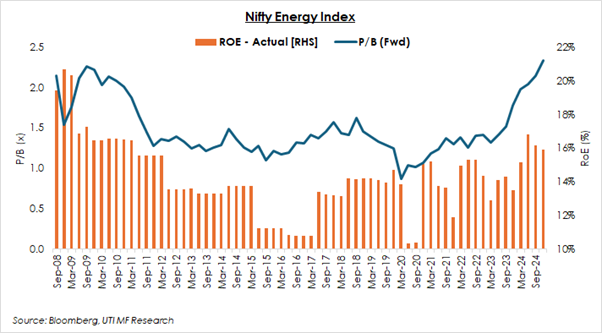
We missed the initial move in 2022; however, we corrected this mistake in 2023. The entire energy sector was available at extremely cheap valuation during 2020-22 at depressed earnings and high dividend yields. However, the situation has now reversed, the valuation of many resource companies is at a multi-year peak while margins are also at elevated levels.
We are now refocusing on the ability of those companies to generate free cash flows and avenues to deploy capital at healthy ROIC projects. These filters suggest some of these names are trading at significant premiums to Intrinsic Value and warranting caution. While profitability has improved, the FCF profile of many companies remains weak. Current valuations are ignoring this nuance; we believe this sector is close to cyclical peaks in terms of valuations and profitability.
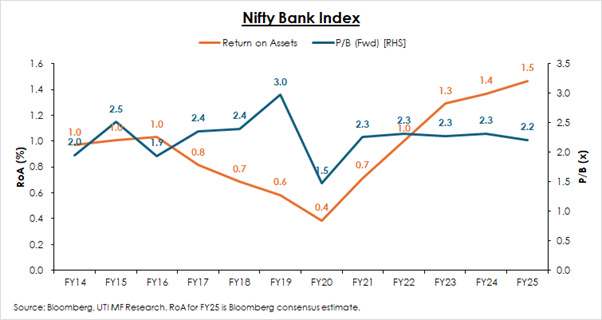
After the multiyear cleanup of the banks’ balance sheets, they have demonstrated agility to navigate the macros over the last four years without major accidents. The regulatory environment has turned proactive, ensuring diagnosis of the issue is done at an early stage and largely eliminating terminal risk.
However, the markets have excessively focused on irritants like quarterly volatility in margins or funding pressure on account of the high systemic Loan-to-deposit ratio (LDR). At the same time, the market has ignored the highest ROA profile in history, mid-teen loan growth in an environment of low single digit volume growth across sectors, decent asset quality, adequate capital. This sector stands out from an intrinsic value framework and provides an opportunity for those of us who follow intrinsic value approach.
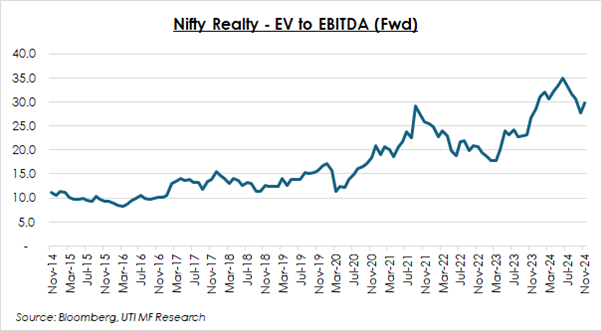
We have witnessed the full cycle of valuation getting played out in the real estate sector. It seems like we are back in 2006-2008, when the dominant investment argument was the inherent value of the land bank and the company’s ability to convert that land into cash flows for investors. When we looked at the sector in 2020, after a decade of underperformance, we found a bruised market that was reluctant to consider companies with low debt, significant land bank, valuation at discount to NAV, low levels of new launches and, single digit inflation in property over the decade.
The cycle turned after 2020, with demand increasing sharply, inventory levels dropping and, price hikes in key markets. Currently, we are in an environment of relatively lower affordability, sharp increase in launches and, steep rise in property prices. The market valuation cycle has moved from significant discount to NAV to premium to NAV and is moving toward EV/EBITDA as metrics to justify valuation. We have come a full circle in terms of valuation and supply-demand dynamics.
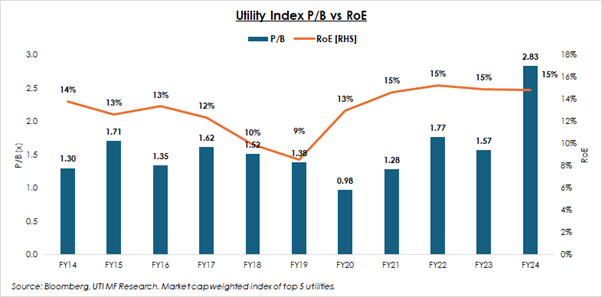
The utilities sector has largely stable return ratios with steady dividend payouts. In 2020 this sector was available in many cases at a discount to book value. Thermal power capacity addition had virtually stopped, while power demand grew at mid-single digits. The expectation was that renewable energy would largely be able to meet the rising demand.
However, the lack of storage avenues for renewables led to a peak power shortage and a sharp rise in merchant tariffs. As this cycle played out the valuation of both public and private utilities inched gradually at first and then sharply. We are now in an environment where announcement of MOUs with state governments are driving market caps. We have seen this play out before, and it did not end favorably.
The valuation of some of these private utilities is at 4-6x BV with mid-teen ROEs, in an environment of changing technology landscape in renewables as well as execution challenges in hydro/ thermal/ pumped hydro. The market is currently ignoring these risks, and pricing in the current tight supply-demand dynamics perpetually for a largely regulated business. All of this is making us very cautious.
To summarise, in this environment of elevated valuation – backed by a sharp increase in profitability – we must take a step back and reflect on whether we are repeating the mistakes of the previous cycles.
Order books are healthy but the possibility of a slowdown in growth is high, given fiscal tightening has begun. The mix of fiscal thrust including the state budget, is moving towards benefit transfer over capex. We may already be at the late stage of fiscal policy driven capex revival, with the mantle of growth to be taken by consumption or private capex. If not impossible, it definitely is difficult to predict when the music will stop. We think market valuation is above average while earning growth numbers have started decelerating. Hence, we calibrate our lever away from being aggressive towards being defensive.
As we continue to focus on the principle of Intrinsic value, we believe it’s time to get back to investing in stocks with a strong cash flow profile with ability to fund its growth journey without dependence on external sources of capital and available at reasonable valuations. We continue to be cautious about narrative driven sectors/stocks.
The views expressed are the author’s own views and not necessarily those of UTI Asset Management Company Limited. The views are not investment advice and investors should obtain their own independent advice before taking a decision to invest in any asset class or instrument.
Mutual Fund Investments are subject to market risks, read all scheme related documents carefully.

Discover more topics
Don't miss any update
Be the first to get exclusive offers, articles and news on our product directly in your inbox.


