
Patience through the lean years
 6 min
Over the last few quarters, investors have become anxious and impatient as stock markets have moved sideways for nearly two years. For many young investors who started investing in equity markets around the COVID-19 period, this is the first time they have witnessed a phase of anaemic returns.
However, a study of historical returns clearly suggests that it is quite normal for investors to earn below-average returns over prolonged periods. An analysis of the period from 2008 to the present shows that five-year returns generated by monthly SIPs (Systematic Investment Plans) in the Nifty 500 TRI have been in single digits 28% of the time. SIPs remain one of the best ways for investors at large to invest in the markets in a disciplined manner without stressing about how to time them. But this does not mean that SIPs, even when continued for five years, will ensure that investors earn the long-term average return of around 13% at all points in time. However, if one continues to invest through SIPs without getting bogged down by poor near-term performance, history suggests that patience is rewarded and returns tend to revert towards their long-term average over time.
At the core of this mean reversion towards a 13% return is the underlying earnings potential of Indian companies. The Indian economy has been growing at a real rate of around 7%, with average inflation of around 4-5%, leading to nominal GDP growth of around 11-12%. In line with nominal GDP growth, corporate earnings have also grown by around 12-13% on average. Together with a dividend yield of around 1%, this leads to the magical number of around 13% returns from the broader markets. While this template should broadly hold in the future, the exact returns will be a function of India’s nominal GDP growth and corporate earnings growth. Should these numbers remain close to what they have been over the past couple of decades, returns should also be similar.
While nominal GDP growth is fairly stable and moves within a narrow band from year to year, corporate earnings growth is more cyclical and fluctuates within a slightly broader band around the mean. However, markets are significantly more volatile than corporate earnings and can see wild swings from one year to another. While markets should deliver returns in line with long-term earnings growth over time, in the short run they can massively undershoot or overshoot corporate earnings because investors can become extremely cheerful and bullish at times, and extremely despondent and bearish at others. It is precisely to insulate oneself from these emotional reactions that investors should follow a disciplined approach to systematic investing. Otherwise, investors may end up buying at the peak and selling at the bottom and may never capture the true return of the underlying asset.
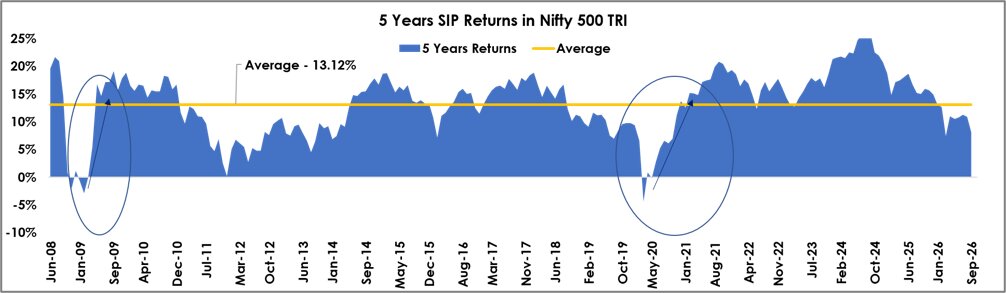
Source: ACEMF Nxt, UTI AMC Research. 5-year rolling SIP CAGR on monthly frequency since Sep-2008 to Aug-2026. Minimum & Maximum 5-year returns over the said period had been -4.4% and 25.9% respectively.
Let us now analyse the chart above carefully. Each point represents the return generated by a monthly SIP over a five-year period. As the chart shows, the average five-year return from monthly SIPs in the Nifty 500 TRI is 13.09%. Let us first consider some extreme cases. In November 2008, amid the Global Financial Crisis (GFC), five-year SIP returns had turned negative. However, for the patient investor who persisted with SIPs, five-year returns rose to 15% within a year. Similarly, during COVID-19, five-year SIP returns turned negative but bounced back to 15% within a year.
The opposite is equally true. There are times when five-year SIP returns have been above average, but they do not remain there for long. Throughout 2010, five-year SIP returns were 15% or higher, though they fell to single digits in 2011 and 2012. Similarly, for most of 2017 and early 2018, five-year SIP returns were above 15%, but they fell into single digits for most of 2019 and 2020. The biggest lesson from this chart is that although equity markets are volatile, they also mean reverting. If one keeps investing assiduously over time to build a nest egg, one can capture the long-term average return despite global events, recessions, slowdowns and external shocks. In fact, phases like the present one can be beneficial for long-term investors. The chart shows that, at least historically, whenever five-year SIP returns have been in single digits, they have bounced back towards the long-term average of 13.09% within a couple of years.
Finally, equity returns are nothing but a reflection of how businesses across different sectors of the economy are performing. If one is confident about India’s long-term growth potential, the best way to participate in it is by becoming a part-owner of a wide variety of businesses and investing a portion of one’s savings in a disciplined manner over time. However, the rewards accrue to those who remain patient, calm and persistent through the inevitable ups and downs of the markets. Successful long innings are rarely built by scoring at the same rate in every over. There will be quiet periods and high-scoring phases; what matters is staying at the crease and letting compounding to build the final score. This is precisely where SIPs are one of the most effective mechanisms for most investors.
Disclaimer:
The views expressed are the author’s own views and not necessarily those of UTI Asset Management Company Limited.
All illustrations/ examples are purely meant for ease of understanding of the concepts and aid in planning by the investor. All illustrations/ examples that depict future values or other estimated numbers are based on reasonable assumptions and in no way give any guarantee or assurance or indication of the future performance. Different types of investments involve varying degrees of risk, and there can be no assurance that the future performance of any specific investment, investment strategy, or product made reference to directly or indirectly in this article, will be suitable for your portfolio. Please note that past performance may or may not be sustained in future and is not a guarantee of any future returns. The views and opinions expressed in this article are based on current market conditions and available information and are subject to change. The reader is urged to consult his or her financial advisor before making any investment decisions.
UTI Asset Management Company Limited (UTI AMC) or UTI Mutual Funds (UTI MF) along with its affiliates assumes no obligation to update or otherwise revise these estimates
Mutual Fund investments are subject to market risks, read all scheme related documents carefully.

Discover more topics
Don't miss any update
Be the first to get exclusive offers, articles and news on our product directly in your inbox.


