
Why YTMs of funds may misrepresent the ‘realised carry’ earned by the scheme?
 4 min
Investors often base their fixed-income investment decisions on the reported Yield to Maturity (YTM) of the funds. They do this by choosing the highest YTM fund out of all comparable funds. The basis for this has been an expectation of higher accrual income in a higher YTM fund.
However, at a time when a lot of these funds have exposure to floating rate papers, it becomes important to understand if the reported YTMs of these funds truly represent the realisable accrual rate of the fund.
To understand the same, we have compared 2 G-secs with similar maturity: one with fixed cash flows and the other with floating cash flows:
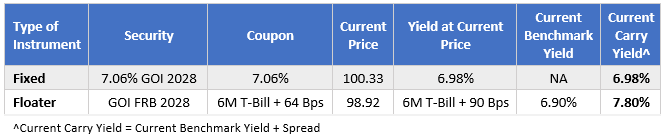
As can be seen from the table above, the current carry yield on a 5-year floating G-sec looks much higher than on a 5-year fixed G-sec. However, at a time when rates are close to the peak, and the next move is expected to be a rate cut, the realised carry yield for investors in a floating rate instrument may be lesser than the current YTM, as the benchmark is reset lower with every rate cut in future.
Hence, the realisable yield of a floating paper can be meaningfully lower than the reported YTM in case rate cuts take place in the coming future. In such scenarios, a simple rule of thumb says that the realised yield can be lower than YTM by the quantum of rate cuts if the transmission of rate cuts is perfect in the benchmark.
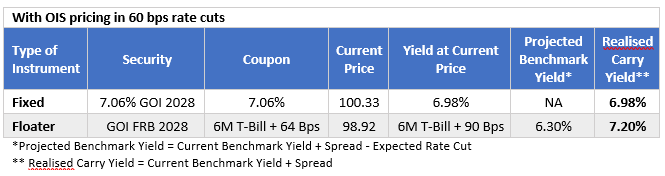
As the above table explains, the realised carry of the floating rate paper reduces by the cumulative rate cuts compared to its current carry yield. Hence, if there are 60 bps rate cuts in the future (as priced by the OIS market), a floating paper – which was yielding 7.80% currently – is expected to deliver a realised yield of approx. 60 bps lower compared to its current carry yield.
Is there a right way of comparing the YTMs of different funds with different percentages of floater exposure?
Realisable YTM of a floating paper over its maturity is not known in advance and it depends on future interest rate moves, unlike a fixed rate paper where realisable YTM is known in advance.
Calculating the realisable YTM of floating rate paper precisely can hence be complex. However, for simplicity, a closer approximation of realisable YTM of floaters can be the current YTM of the floater minus the expected rate cuts by the central bank.
Hence, to adjust the reported YTMs of a fund (to reflect the true realisable yield of a fund), investors can reduce the YTM of the fund by basis points equal to the expected rate cuts multiplied by percentage exposure to floating rate papers.
For example, if the reported YTM of a fund with 30% floater exposure is 7.75% and the investor expects cumulative rate cuts of 60 bps in the near term, the realisable YTM is expected to reduce by 18 bps (60 bps rate cut X 30% floater exposure). Hence, the approximate realisable YTM is expected to be 7.57% (7.75% - 0.18%) which is much lower than the reported YTM of the fund. This adjusted realisable YTM of the fund is truly comparable to the YTM of any other fund with no exposure to floater papers and can be helpful for investors in making the right investment decision if the deciding criteria is the YTM of funds under comparison.
Disclaimer
The above realisable YTM calculations are based on the following assumptions:
- Any rate change in the economy perfectly transmits into the benchmark rate, resulting in equivalent movement in the benchmark.
- The above-mentioned realisable YTM reflects only the accrual income earned on such papers and does not consider any mark-to-market movement. Hence the realisable YTM of a fund may be different from the realised return by the investors.
The views expressed are the author’s own views and not necessarily those of UTI Asset Management Company Limited. The views are not investment advice and investors should obtain their own independent advice before taking a decision to invest in any asset class or instrument.
Mutual Fund Investments are subject to market risks, read all scheme related documents carefully.
Discover more topics
Don't miss any update
Be the first to get exclusive offers, articles and news on our product directly in your inbox.