Knowledge Center

E-books
Learn about financial planning and mutual fund investing by reading our exclusive e-books.



What comes to your mind when you think of making investments for future needs?
Surely, your mind immediately races towards major needs in the distant future, be it investments for child’s college or your retirement. At the same time, there would be many needs that need to be met much earlier, typically in 3-4 years of time. This would typically be requirements like money for home down payment, vacation, besides child’s school admission expenses.
As an investor, your choice of investments will be very different for these needs when compared to investments for the ones in the distant future. Let’s take a closer look.
Separate investments
For distant needs like child’s higher education, consider higher risk investments that also have a potential for high growth in the long term. This typically takes you to equity funds, which invest in equities. Due to these investments, equity funds experience short term turbulence. However, these bumps typically smoothen out over a longer period of, say, 8-10 years, or more.
Mutual Fund Investments are subject to market risks, read all scheme related documents carefully.

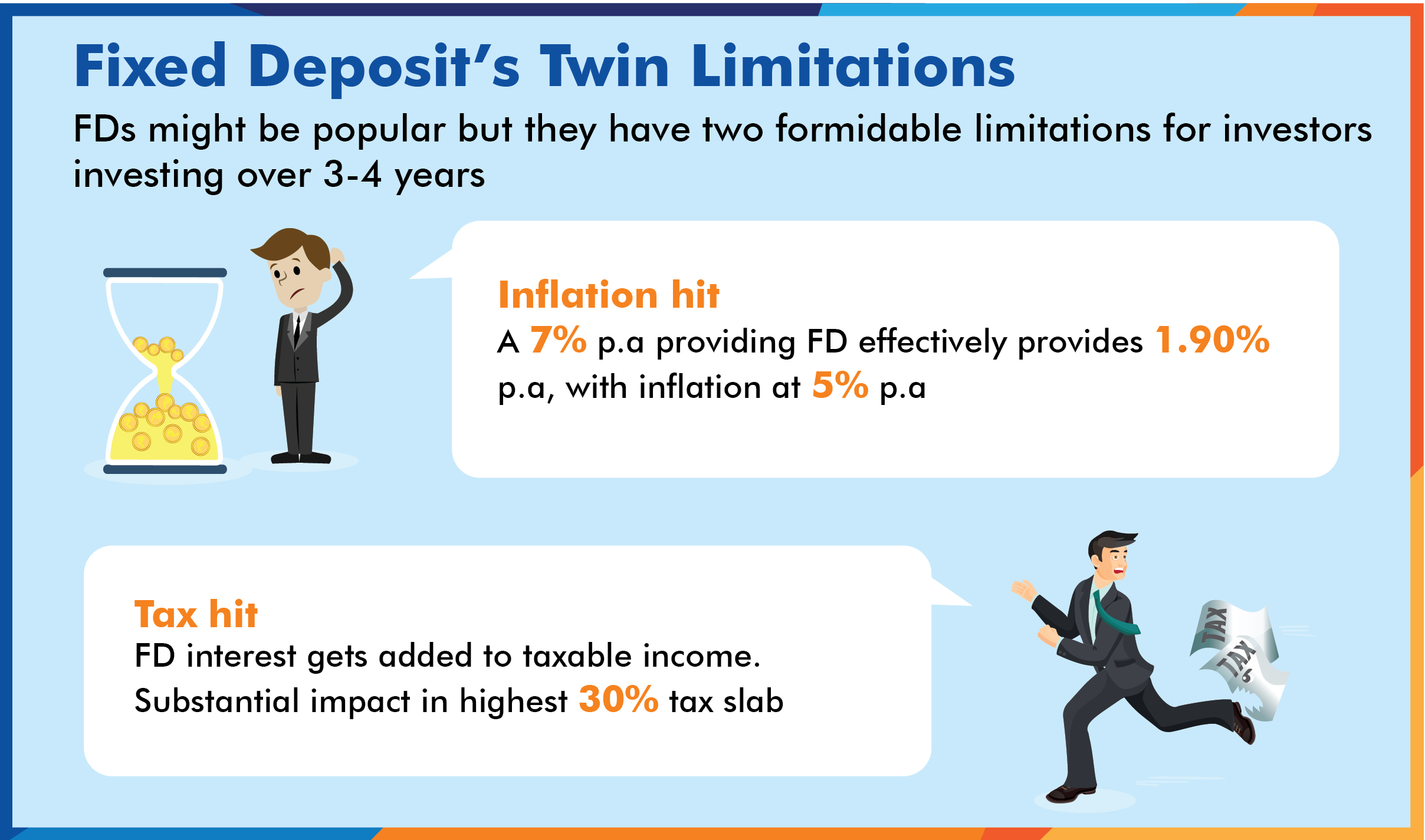
When it comes to different investment options in India, fixed deposits (FD) top the popularity charts. It is not unusual to find people having invested in them for all kinds of needs, be it those for the longer-term or to meet imminent needs. Unfortunately, this often means ignoring four potent dangers faced by FDs.
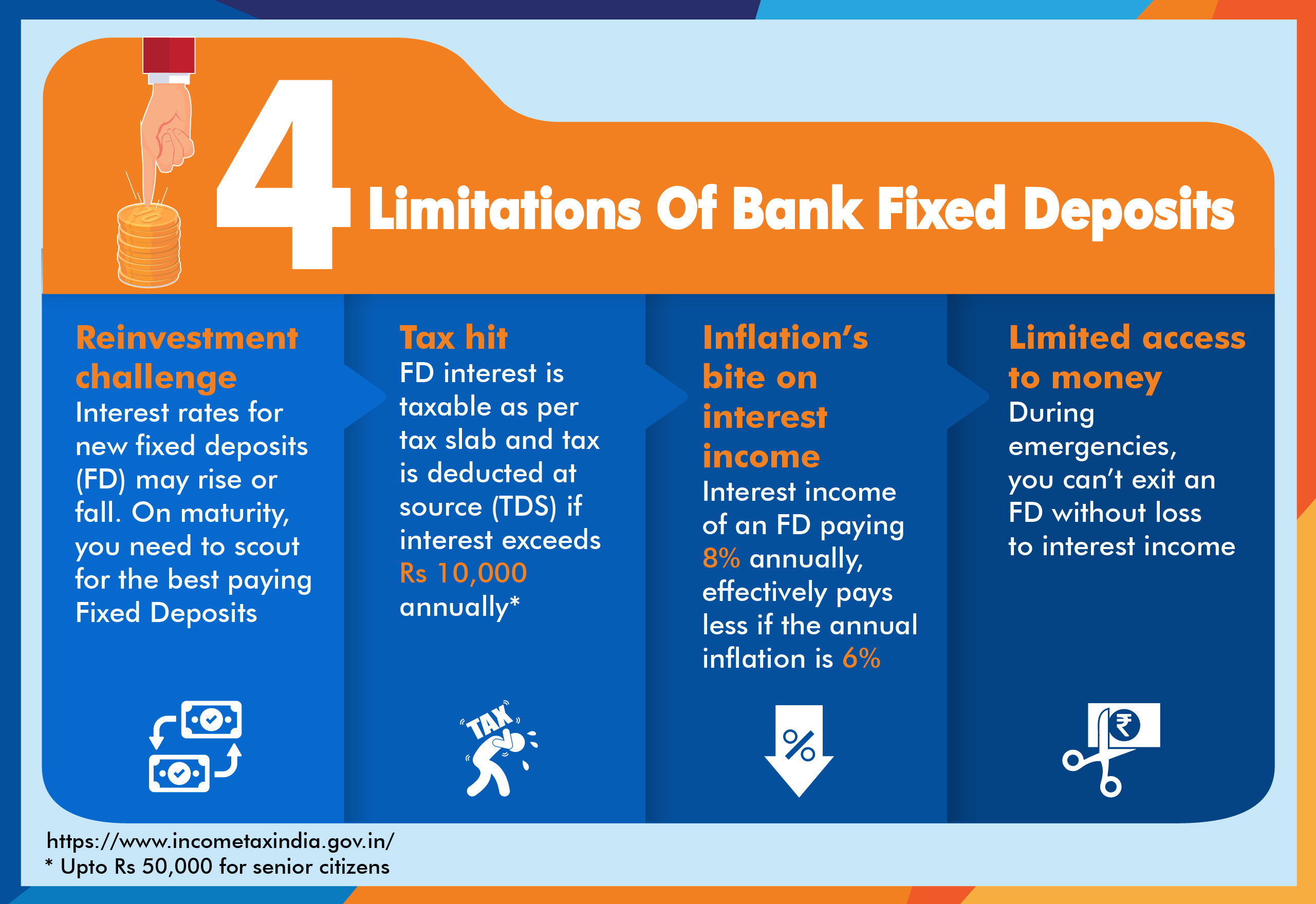
Four Limitations Of Fixed Deposits
Keeping up with interest rates
Interest rates keep changing from time to time and with them, interest rates for fresh FDs. However, the interest rate offered for a particular fixed deposit at the time of investment remains the same during the FD term. For instance, a 3-year FD providing 8% annual interest will continue to provide the same interest rate even if the interest were to increase or decrease the next year.
However, the investor confronts a challenge when the FD matures and the investor needs to re-invest it. During a period of falling interest rates, the investor needs to hunt for the best rate for the period sought. On the other hand, during a period of rising rates, there is the danger of the investor losing out on getting the best rate.
Tax hit
The interest income from your FD is taxable according to your tax slab. Also, there is a provision of tax deducted at source (TDS) if the interest income is more than Rs 10,000 a year. So, if you are in top tax slab of 30%, and your bank fixed deposits earn 8% p.a, they effectively pay 5.60% p.a.
Mutual Fund Investments are subject to market risks, read all scheme related documents carefully.

Make volatility help you create wealth
The long journey to major financial goals like buying a home, children’s higher education and retirement, is comparable to a long distance flight or a sea voyage. In Air travel you sometimes experience uncomfortable air pockets and choppy seas in case of sea travel. Of course, we don’t interrupt or abandon those journeys because turbulence is a part and parcel of them.
In the journey of investments for financial goals, investors make investments over long periods. In the course of time, they also experience unsettling market turbulence that see the value of their investments fluctuate. Sadly, these experiences make many investors stall or exit their investments.
While volatility is experienced by all categories of investments like those in equity, debt and liquid investments made directly or indirectly through mutual funds, it is in equity investments that the investor reaction is pronounced. They experience volatile periods early on but typically give high returns in the long term i.e. 8-10 years or more. Any disruption in regular investments makes a substantial difference to the final savings.

Mutual Fund Investments are subject to market risks, read all scheme related documents carefully

Here is a simple quiz question. “What do you need to meet life’s major financial goals like children’s higher education and retirement?” You have got it right if your answer is ample savings. But that was the easier part. Here’s the challenging question, “How do you create ample savings for these needs that require substantial sums?” For an individual investor, getting the right answer involves quite some doing as this involves making the right investments over long periods. This is easier said than done.
Challenge of saving for future needs
To save ample amounts, or creating wealth all by yourself, you need to track the fortunes of different investment categories and asset classes which have their own characteristics. This includes risks and tax treatment.
If all this looks like a stressful full-time job, you can relax, for there is help at hand in the form of mutual funds. They offer asset allocation funds that help you meet any specific need by helping you create wealth using the expertise of fund managers.
How asset allocation funds help
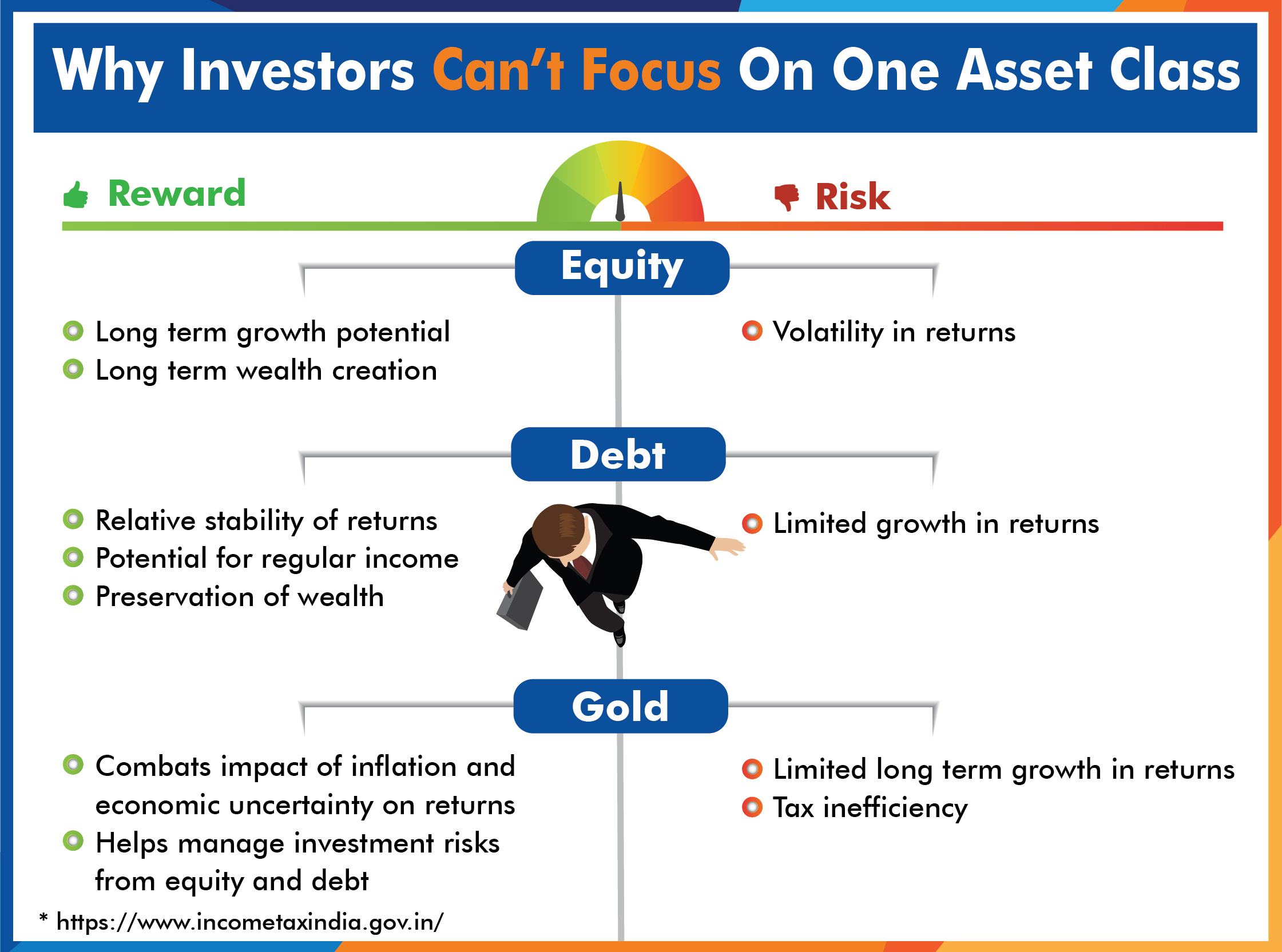
Each asset class such as equity, debt or gold, provide returns for a certain level of risk. For instance, if equities have potential for growth and long term wealth creation, their returns can be volatile too. While debt provides relative stability, there are limitations in the growth possibilities. On the other hand, while gold is helpful when economic and other conditions adversely impact debt and equity, it has limitations like tax inefficiency.
Mutual Fund Investments are subject to market risks, read all scheme related documents carefully.
What comes to your mind when you think of making investments for future needs?
Surely, your mind immediately races towards major needs in the distant future, be it investments for child’s college or your retirement. At the same time, there would be many needs that need to be met much earlier, typically in 3-4 years of time. This would typically be requirements like money for home down payment, vacation, besides child’s school admission expenses.
As an investor, your choice of investments will be very different for these needs when compared to investments for the ones in the distant future. Let’s take a closer look.
Separate investments
For distant needs like child’s higher education, consider higher risk investments that also have a potential for high growth in the long term. This typically takes you to equity funds, which invest in equities. Due to these investments, equity funds experience short term turbulence. However, these bumps typically smoothen out over a longer period of, say, 8-10 years, or more.
Mutual Fund Investments are subject to market risks, read all scheme related documents carefully.
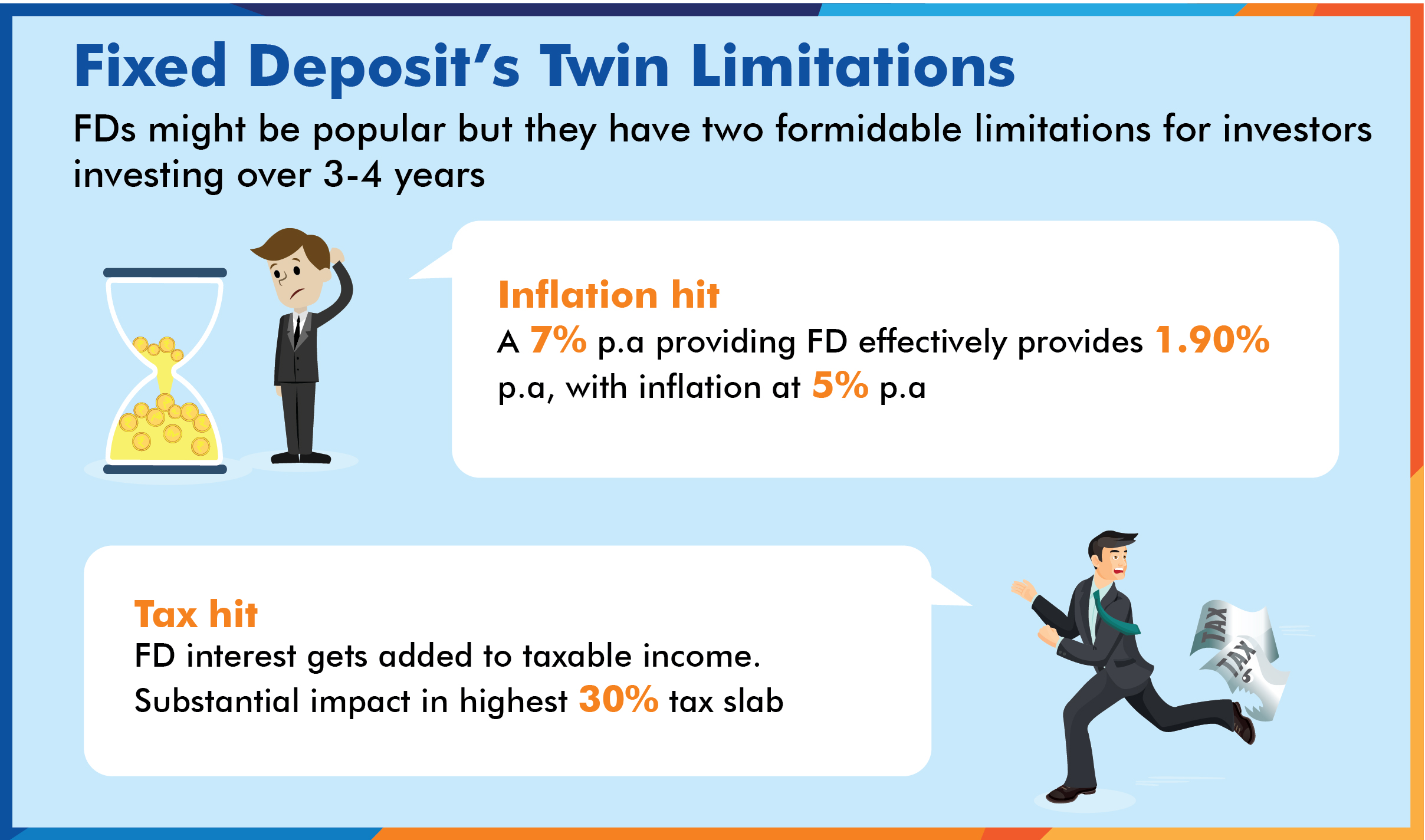
When it comes to different investment options in India, fixed deposits (FD) top the popularity charts. It is not unusual to find people having invested in them for all kinds of needs, be it those for the longer-term or to meet imminent needs. Unfortunately, this often means ignoring four potent dangers faced by FDs.
Four Limitations Of Fixed Deposits
Keeping up with interest rates
Interest rates keep changing from time to time and with them, interest rates for fresh FDs. However, the interest rate offered for a particular fixed deposit at the time of investment remains the same during the FD term. For instance, a 3-year FD providing 8% annual interest will continue to provide the same interest rate even if the interest were to increase or decrease the next year.
However, the investor confronts a challenge when the FD matures and the investor needs to re-invest it. During a period of falling interest rates, the investor needs to hunt for the best rate for the period sought. On the other hand, during a period of rising rates, there is the danger of the investor losing out on getting the best rate.
Tax hit
The interest income from your FD is taxable according to your tax slab. Also, there is a provision of tax deducted at source (TDS) if the interest income is more than Rs 10,000 a year. So, if you are in top tax slab of 30%, and your bank fixed deposits earn 8% p.a, they effectively pay 5.60% p.a.
Mutual Fund Investments are subject to market risks, read all scheme related documents carefully.

You like the sound of the ping on your mobile phone informing when pay gets credited every month. But how can you ensure that the sweet sound continues even in retirement? You will still need a regular income to meet your regular expenses. That’s not all.
You also need to meet periodic expenses such as home repairs and maintenance, besides have lump sum requirements from time to time, especially during family events like marriages. That’s not to forget the needs for emergency cash due to possible health and other emergencies. How will you do all this and not let your retirement become all about managing money? The answer lies in investing in debt mutual funds.
By investing in different categories of debt mutual funds and using their various features, you can ensure that not only do you get regular retirement income, but also meet periodic expenses, lump sum requirements, besides meeting emergency needs. Debt funds can help your money grow well thanks to tax efficiency and capability to counter inflation. Remember, inflation quietly eats away the purchasing power of retirement savings.
Here, we will tell you how retirees can smartly use mutual funds. But before we do that, we will give you a financial big picture of retirement. This will help you appreciate the utility of debt mutual funds even better.

Mutual Fund Investments are subject to market risks, read all scheme related documents carefully.

Create wealth by smartly managing risks
Like the landscape of beaches and deserts constantly being altered by sea-waves and desert winds, the investment landscape throws up many unexpected surprises. While it may not be apparent to many investors, but each investment option comes with its own set of unique risks that lead to unexpected pleasant and not-so-pleasant results. Thus, the challenge is to manage the risk from the uncertain outcomes for investments for major financial goals like children’s higher education and retirement in a way that ensures persistent growth. To do it you need to ensure that you grasp the essentials about risk associated with investments and its relationship with returns.
Understanding Risk
What is Risk?
A simple way of understanding risk is that it is the possibility of actual returns ending up being different from expected returns. Greater the possibility of actual returns varying from expected returns, greater the risk. Thus, equity investments have a higher risk compared to fixed income investments such as a fixed deposit (FD) or a debt fund investment.
What every investor must know about risk
Ideally, investors will not want the divergence between expected and actual returns. However, the reality is that every investment has its own set of risks which makes this divergence a reality that investors have to live with. It is just the degree of divergence of returns that significantly depends on the investment. Thus, a 7% per annum interest paying bank FD may not witness any divergence between expected and actual returns. However, an equity investment may return 5% p.a to an investor who expected a higher return, say 10% p.a. The same investment, over a longer time period, could deliver 12-14% p.a.
To download full eBook Click here
To know about your risk appetite, use our Risk Analyser calculator
Mutual Fund Investments are subject to market risks, read all scheme related documents carefully.

For some, any talk of financial independence for women may conjure up thoughts of feminism. However, a closer look at the unique issues and circumstances that women typically face provides a compelling financial and economic logic for womenʼs financial independence. That is why it is so important for all people, especially women, to know why they need to be financially independent and how they can achieve financial independence.

Mutual Fund Investments are subject to market risks, read all scheme related documents carefully.

Why not commemorate India's 75th Independence Day this 15th August by taking concrete steps towards attaining the financial freedom that you've always dreamt of? But what is financial freedom?
In simple words, it is the ability to handle contingencies and manage expenses effortlessly to live life to the fullest without financial dependency on others. And yes, it is possible! All it requires is some careful planning coupled with prudent investment in mutual funds. So let's find out how mutual funds can get you started on this all-important journey of financial freedom.
Start Early to Finish Early
To build a financially strong foundation, it's vital to start investing as early as possible. It helps spread your risk and amassing a sizeable corpus through the magical power of compounding.
A portfolio with the right asset allocation strategy based on your risk profile can give you higher return potential to ensure a financially secure future.
Fulfil Financial Goals
Mutual funds that offer a multitude of schemes are designed to meet diverse financial aspirations. The popular asset class has something for everyone. You can choose financial instruments that align with your specific goals and risk profile. While debt funds are ideal for achieving short and medium-term goals, equity funds can help generate wealth over the long haul.
Wealthy Retirement
The importance of self-sufficiency in the twilight zone cannot be stressed enough. While the pension can take care of general expenses, a retired person must be prepared to beat the increasing inflation rate.
The Systematic Investment Plan (SIP) offered by mutual funds is a good bet. The facility that pushes you to invest in a disciplined manner can help build a retirement kitty without straining your budget.
Tax Exemptions
Proper tax planning can help channelise a lot of your hard-earned money towards reserves for your future. Selecting the right investment avenue can lower your tax liability under Section 80C of the Income Tax Act. Mutual fund investments such as the Equity Linked Saving Schemes (ELSS), while it helps saving tax and help your money grow to fulfil your quest of becoming financially independent.
Provide Liquidity
It's prudent to maintain a financial reservoir that can be tapped into if an unexpected situation such as a medical crisis or job loss were to emerge. Stashing idle cash in liquid and overnight funds is perfect for handling such contingencies as they are less prone to market fluctuations and easy to exit.
What's more, they can also earn a return. The short-duration securities provide liquidity to help tide over a challenging situation without fretting about sustenance or denting your egg nest.
This Independence Day Work Towards Your Financial Independence
What say, ready to make financial Independence a reality by taking the mutual fund route?
Happy Independence Day to All!
Disclaimers:
Mutual Fund investments are subject to market risk, read all scheme related documents carefully. This material is part of Investor Education and awareness initiative of UTI Mutual Fund.
The information herein should not be considered as 'investment advice'. Reader is requested to make informed investment decisions and consult their Mutual fund distributor or financial advisors to determine the financial implications with respect to investing in Mutual Funds.
