


Article summary:
-
A direct mutual fund is the one you invest in directly from the fund house, either from its branches or online from its website or mobile application.
-
A regular mutual fund is the one you invest in through a mutual fund distributor, bank, or any other financial institution.
-
While direct mutual funds have relatively lower expense ratios, regular mutual funds offer the benefit of professional advice.
As a new mutual fund investor, you might get to hear about direct mutual funds and regular mutual funds. Before investing in a mutual fund, you need to understand the crux of the regular vs. direct mutual fund difference, essentially two ways of buying mutual funds, and understand which one works for you. Let us explain the difference between regular and direct mutual funds with a real-world analogy. Consider this: You can get your favourite ice cream through a mobile food app or just walk down to the nearest neighbourhood store and grab one yourself. In the first instance – you used an intermediary to complete your purchase, while in the second one, you went directly to the shop and made your purchase. While purchasing mutual funds too, you can take the help of an intermediary (regular plan) or directly purchase from the fund house online (direct plan). Let’s understand both plans in detail.
Direct Mutual Fund Meaning
Similarly, you can invest in a mutual fund directly from the fund house either from its branches or online from its website or mobile application. This is what is termed as a direct mutual fund.
Regular Mutual Fund Meaning
Alternatively, you could invest through the traditional route of taking the help of a mutual fund distributor, financial advisor, bank, or a financial institution for investing in it. This is called a regular mutual fund.
Differences between Regular and Direct Mutual Funds:
The essential difference: When you buy a regular mutual fund scheme you pay commissions to the distributor whether it is a mutual fund distributor, bank, or any other financial institution. This is an expense that is paid out from the value of investments and hence, dents the returns and growth you receive from the investments. In a direct mutual fund, this expense is absent.However, in regular mutual funds, you also benefit from the professional advice and assistance you receive from a mutual fund distributor, which you don’t get in the direct option.
Let’s look at a few more differences between the two types of mutual fund investments:
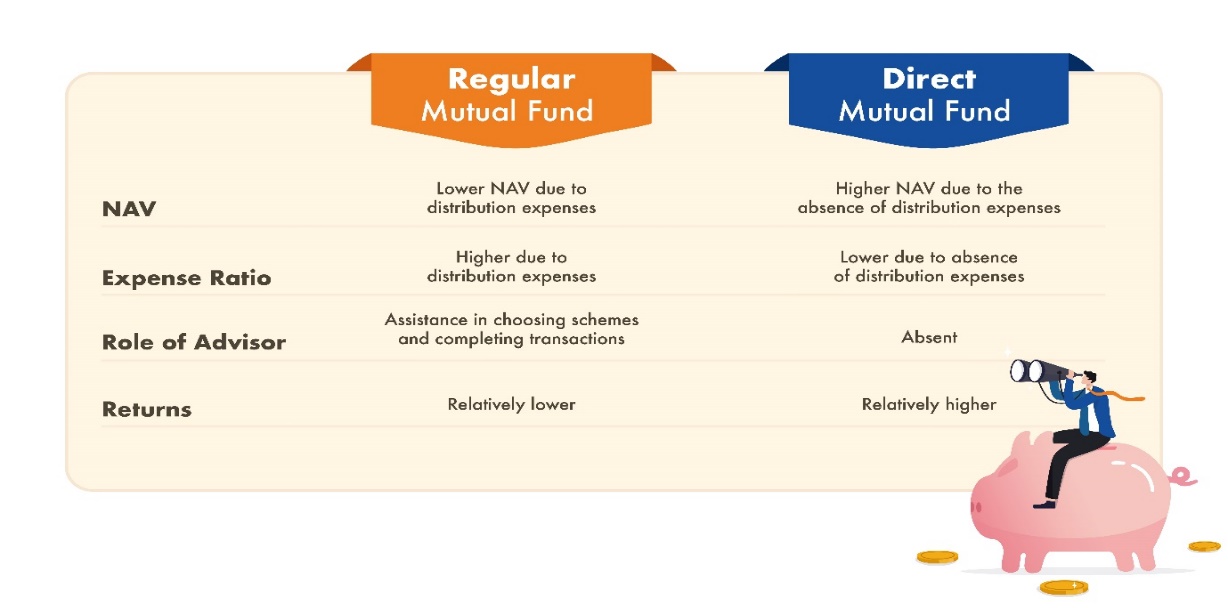
1. Impact on NAV: A casual look at the fund performances over different periods for direct fund and regular fund will indicate variation in NAVs. For investors looking to grow their money with investments in the growth option, the comparison of NAVs of direct growth vs regular growth plans, you will find the NAV of direct plans being higher. They bear testament to the impact distribution costs have on the direct growth vs regular growth contest.
2. Expense ratio: Distribution commissions also get reflected in the expense ratio which indicates the expenses incurred by the mutual fund as a percentage of the funds corpus or Assets Under Management (AUM). Higher the distribution costs, greater the impact on expense ratios. Since direct mutual funds do not incur these costs, they have lower expense ratios than regular mutual funds.
Read More - Index Funds vs Active Mutual Funds – Key Differences
3. Returns: Due to lower costs from the absence of distribution costs, the returns for direct mutual funds are higher than those of regular mutual funds.
4. Role of advisor: Investors new to mutual funds need guidance from a qualified financial advisor to choose the right investments to meet various financial needs. In the case of a regular mutual fund, the mutual fund distributor may offer guidance and assistance in making transactions.
Differences Between Regular And Direct Plans At A Glance:
Direct vs Regular Mutual Funds: Which One Is for You?
If you’re new to mutual funds or unsure about how to invest or which scheme to invest in, you may consult a financial advisor or mutual fund distributor and take his/her assistance to start investing. As you gain experience investing in different mutual funds and get exposed to different situations, you may consider fresh investments in direct plans. This process may occur earlier for investors who invest in lower risk or passive investments like liquid funds and index funds respectively, which may be more suitable for beginners.
To sum up the regular vs direct mutual fund discussion, the difference between regular and direct mutual fund is essentially one about the role of costs of distributor commissions vs. assistance in investing. While new investors may do well to rely on regular plans, knowledgeable investors can consider direct plans.
FAQs:
Can I switch from direct to regular or regular to direct?
You can switch from direct to regular or regular to direct by either placing a request online or conducting this change offline with the help of a mutual fund distributor or by visiting the branch of the Asset Management Company (AMC). Please note that a switch is considered as redemption/sale of mutual fund units, so it may attract capital gains tax. The capital gains can be long or short depending on the holding period, and the applicable taxes will vary accordingly.
Who should invest in direct plans?
Investors with experience of investing in mutual funds can consider fresh investments in direct plans. For new investors gaining experience, this wait can be shorter for investments in lower-risk or passive investments like liquid funds and index funds and exchange-traded funds (ETFs), respectively.
How do distributors get their commission?
The distributor gets paid according to a fixed percentage of the market value of your investment in the scheme and the payment keeps happening till you remain invested. Distributor commissions form part of the expenses that get adjusted with the scheme’s Net Asset Value (NAV).
Read More - 7 Benefits You Get From Investing In A Mutual Fund