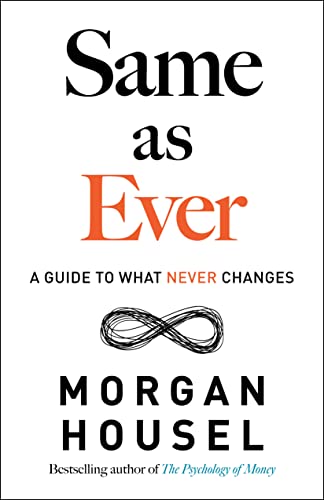
Investment lessons from Morgan Housel’s Same as Ever: Timeless Lessons on Risk, Opportunity and Living a Good Life
 30-09-2025
Comments by: V Srivatsa
The unchanging truths every investor should remember
In an era where the constant mantra is ‘change is constant and everyone must adapt’, it feels refreshing to come across Morgan Housel’s book titled Same as Ever.
The book discusses what remains unchanged in the world over centuries, which is best summed by a Jeff Bezos quote: “What will not change is the thirst of shoppers to get low prices and fast shipping.” Amazon is working towards achieving this. Hence, while the entire technology landscape can change, human behavior remains largely unchanged.
I summarise the key learnings from Housel’s book Same as Ever: Timeless Lessons on Risk, Opportunity and Living a Good Life. Here’s how these learnings are relevant to fund and asset management:
1. Risk is what you don’t see: The author illustrates this with a strong example of how a widely known risk never played out while an unforeseen risk did. For instance, the risk of a nuclear bomb being built by many countries never materialised into a nuclear attack, since the very existence of these weapons acts as a deterrent to attacks. On the other hand, COVID-19 was barely seen as a risk even in January 2020, yet it became one of the biggest events impacting global economies.
This shows that true risks often emerge from what is left off the list of “known risks”. My key learning here is to be aware of the possibility of an unpredicted storm or hurricane and act accordingly.
2. Expectations and contentment: The author argues that happiness often stems from low expectations and having them met. He compares the 1950s and 1980s in the USA, noting that while people fondly recall the 1950s as the golden era of happiness, the actual quality of life – measured by healthcare, standard of living and life expectancy – was far superior 30 years later. The key difference was lower inequality as most people had similar standards of living, which kept expectations modest, leading to increased contentment.
My key takeaway is to temper expectations in equity markets by focusing on long-term trends. The reasonable returns over a 15-year horizon may be 12-15%, but outcomes in shorter 5-year blocks may vary widely. Investors often suffer from recency bias and tend to extrapolate the next couple of years’ returns based on the last few years’ returns. It is highly likely that returns will normalise to the long-term average, both on the upside and the downside.
3. Too much and too soon: The author highlights the perils of growing too fast and its consequences. It is inherent in our lives to fast-track growth and progress, but in most cases, it leads to heartburn. Housel cites the example of a man who was 10 feet tall and weighed around 400 pounds. While this might sound like Superman, in reality, he was bedridden, barely able to walk and died young. Similarly, fish made to grow rapidly in artificial conditions often have higher mortality rates than naturally grown ones.
The key lesson for me is to be cautious of companies that grow too fast without systems in place, as they often end up destroying value for shareholders in later years. While markets are fascinated by growth-oriented companies, not all of them succeed in creating value for shareholders in the long run.
4. Tiny and magnificent: The author talks about little things that compound into extraordinary things. He gives the example of how tiny cells evolved into human beings over a very long period, with incremental changes hardly noticeable. The rate of change is slow and tedious, as nature selects traits for survival and minuscule changes compound into living beings completely different from their origin.
In the investment world, the best example of “tiny and magnificent” is how average fund performance, sustained over a very long period, results in extraordinary outcomes. A fund that consistently performs in the second quartile and moderately beats its benchmark over many quarters will eventually find itself among the top performers. My objective for funds is to deliver moderate outperformance consistently, which will create long-term value for investors.
5. Elation and despair: Optimism and pessimism are seen as diametrically opposite traits, with people usually classified into one camp or the other. However, the author argues that blending both is essential to survive and lead a contented life. He gives the example of Bill Gates, who is supremely confident of his products and their ability to create value for clients, yet still believes in keeping one year’s expenses as cash reserves to tide over emergencies. The author coins the phrase “save like a pessimist and plan like an optimist,” which resonates strongly and is a valuable principle for financial planners.
My key learning is to act like a pessimist while shortlisting stocks or creating my stock universe and to act like an optimist while building the portfolio from those selections. Good managers are both excellent stock pickers and disciplined stock rejectors.
6. Time horizon management: The long term is nothing but a collection or a series of short-term cycles. While everyone appreciates the importance of the long term, one should not forget that it is built on a series of short phases of the market. Some of us often choose the long-term route as an excuse to hide complacency in the short term. A marathon runner has to remain competitive in all the short runs, otherwise it becomes difficult to catch up at the end.
In fund management, while the ultimate goal is to have a successful long-term performance, the endeavour should be to succeed across the short runs by staying disciplined and diligent. There may be periods when the environment does not favour my style of investing, but I do not lose focus on outperforming in the short run. Having clear short-term goals alongside long-term vision is what makes achieving long-term success possible.
Morgan Housel’s book Same as Ever makes for an engaging read as it offers a series of common-sense insights that are especially valuable for anyone in the world of investing.
Mutual Fund investments are subject to market risks, read all scheme related documents carefully.

V. Srivatsa is an Executive Vice President & Fund Manager –Equity at UTI AMC Ltd. He is a B.Com graduate, C.A., C.W.A. and has a PGDM from IIM, Indore. He has been with UTI AMC since 2002. Prior to joining UTI he has worked with Ford, Rhodes Parks & Co., Chartered Accountants for 2 years and as Officer-Audit in Madras Cements Ltd. He started in UTI AMC in the Department of securities research covering varied sectors such as Information Technology, Capital goods and metals.
He was promoted as fund manager offshore in December 2005 after a three year stint in the DOSR. He was given additional responsibilities of equity portion of hybrid funds in October 2009. He reports to the Head - Equities for both the domestic & hybrid equity schemes.
Other Impactful Books
Don't miss any update
Be the first to get exclusive offers, articles and news on our product directly in your inbox.