Knowledge Center




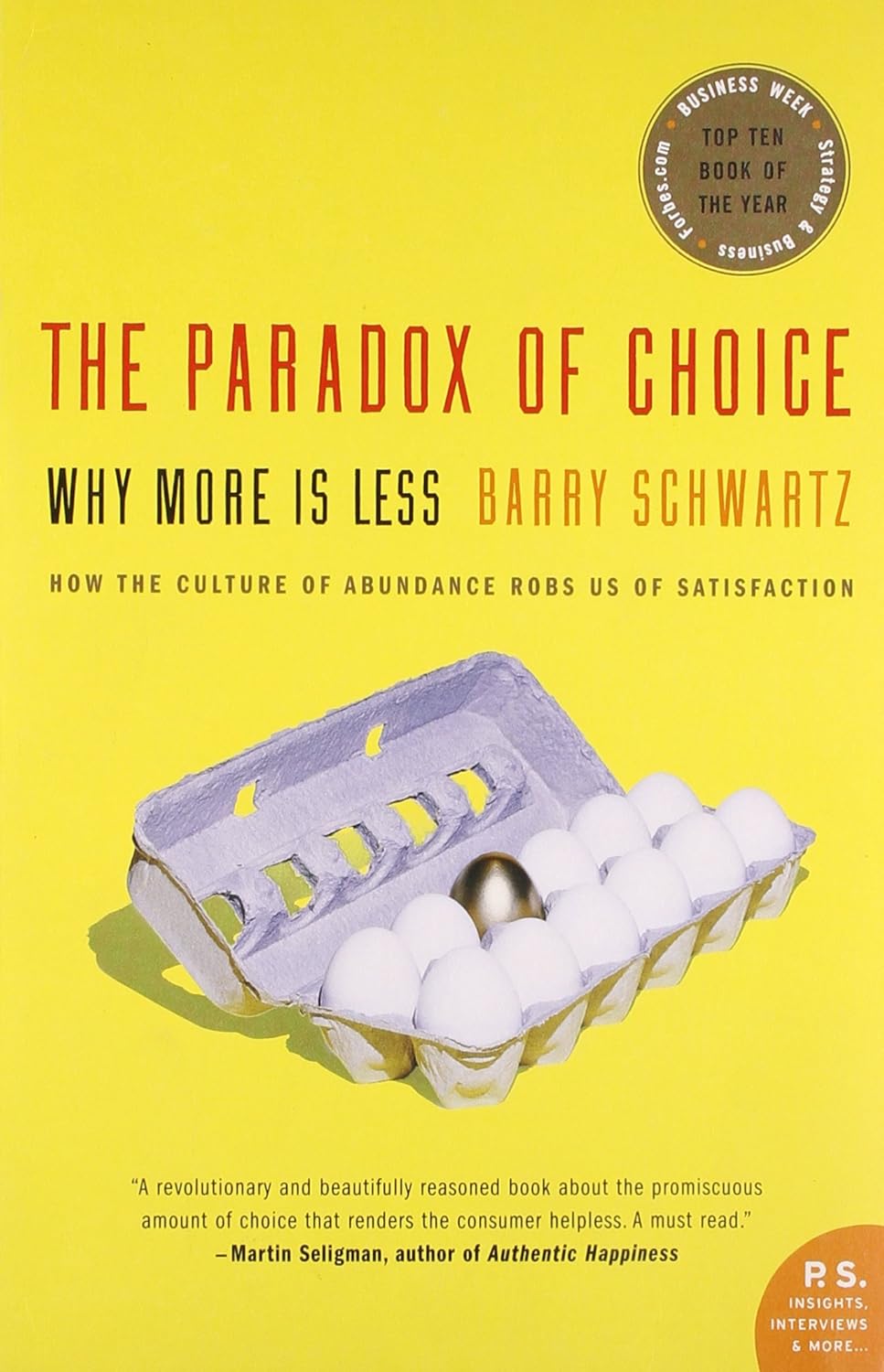
Learnings for Investors from The Paradox of Choice: Why More is Less by Barry Schwartz

Comments by Deepesh Agarwal
January 2026
The paradox of choice in Indian markets
In his book ‘The Paradox of Choice: Why More is Less’, American psychologist Barry Schwartz argues that modern Western societies offer an unprecedented abundance of choices. These include consumer goods, careers, lifestyles, retirement planning and even personal relationships. Paradoxically, this surplus often leads to decreased happiness, increased anxiety, and decision-making paralysis.
Schwartz differentiates between “Maximizers,” who strive to make the absolute best choice by exhaustively evaluating all options, and “Satisficers,” who settle for a choice that is “good enough” based on their criteria.
The central paradox is that more freedom of choice, intuitively linked to greater welfare and autonomy, actually generates several negative consequences:
-
Decision Fatigue: The cognitive burden of evaluating numerous options depletes mental energy.
-
Rising Expectations: With so many options available, we expect a perfect choice to exist, making disappointment more likely.
-
Opportunity Costs: We fixate on the attractive features of the alternatives we reject, diminishing satisfaction with the option we select.
-
Regret and Self-Blame: When outcomes are imperfect, we blame our ability to choose wisely, leading to regret and reduced well-being.
-
Paralysis: The overwhelming array of choices can cause us to defer decisions or avoid them altogether.
Freedom vs. wellbeing
Schwartz’s solution is not to eliminate choice, but to manage it more consciously through the following practices:
-
setting meaningful constraints
-
adopting “satisficing” strategies
-
lowering expectations about the perfection of outcomes
-
making decisions non-reversible, where possible
-
practicing gratitude for the options we choose
-
curbing social comparison
Ultimately, he advocates focusing on what truly makes life meaningful—community, relationships, and personal development—rather than the endless pursuit of optimal selection.
Connection with equity markets
The Indian equity market offers a powerful, real-world manifestation of Schwartz’s paradox.
-
The overwhelming universe of options: For investors, there are approximately 6000 listed companies on the NSE and BSE across sectors. Of these, nearly 1800 companies are above ₹500 cr market cap (Source: Bloomberg), spanning varied sectors, growth profiles, RoCE and valuations. This explosion of choice is both empowering as well as paralysing.
-
The maximizer’s curse in portfolio construction: Such investors chase alpha through endless screening, often suffering from:
-
decision fatigue from Bloomberg marathons
-
FOMO on every IPO and OFS
-
post-buy regret ("Why not that multibagger?")
-
the endless review trap of tweaking holdings quarterly
A maximizer investor tries to maximize returns across every time horizon (year, month, week, or even day). This creates suboptimal outcomes over the long term.
-
The “satisficing” investor as the winner: The most successful long-term Indian equity investing philosophies align closely with Schwartz’s “satisficing” principle, as they follow:
-
Simple, rule-based frameworks (for example, economic moats)
-
Long-term orientation and gratitude (holding winners for decades and ignoring short-term noise)
A satisficing investor doesn’t compare returns with others and remains content if they exceed a certain threshold over longer periods.
Simplification: the ultimate edge
Schwartz's lesson cuts deep for Indian investors. In a market of infinite tickers and 24/7 hype, survival demands deliberate ignorance. Ditch the "click every IPO" frenzy in favour of a lean, conviction-driven portfolio. Wealth—and sanity—come not from sampling everything, but from mastering the art of saying no.
Key conclusion
As the book suggests, the secret to wealth (and mental peace) isn't having the most options; it’s having the discipline to ignore most of them. The paradox winner ignores 99% of options in order to own the 1% that truly matters.
Mutual Fund investments are subject to market risks, read all scheme related documents carefully.



Investment lessons from Morgan Housel’s Same as Ever: Timeless Lessons on Risk, Opportunity and Living a Good Life
Comments by: V Srivatsa
The unchanging truths every investor should remember
In an era where the constant mantra is ‘change is constant and everyone must adapt’, it feels refreshing to come across Morgan Housel’s book titled Same as Ever.
The book discusses what remains unchanged in the world over centuries, which is best summed by a Jeff Bezos quote: “What will not change is the thirst of shoppers to get low prices and fast shipping.” Amazon is working towards achieving this. Hence, while the entire technology landscape can change, human behavior remains largely unchanged.
I summarise the key learnings from Housel’s book Same as Ever: Timeless Lessons on Risk, Opportunity and Living a Good Life. Here’s how these learnings are relevant to fund and asset management:
1. Risk is what you don’t see: The author illustrates this with a strong example of how a widely known risk never played out while an unforeseen risk did. For instance, the risk of a nuclear bomb being built by many countries never materialised into a nuclear attack, since the very existence of these weapons acts as a deterrent to attacks. On the other hand, COVID-19 was barely seen as a risk even in January 2020, yet it became one of the biggest events impacting global economies.
This shows that true risks often emerge from what is left off the list of “known risks”. My key learning here is to be aware of the possibility of an unpredicted storm or hurricane and act accordingly.
2. Expectations and contentment: The author argues that happiness often stems from low expectations and having them met. He compares the 1950s and 1980s in the USA, noting that while people fondly recall the 1950s as the golden era of happiness, the actual quality of life – measured by healthcare, standard of living and life expectancy – was far superior 30 years later. The key difference was lower inequality as most people had similar standards of living, which kept expectations modest, leading to increased contentment.
My key takeaway is to temper expectations in equity markets by focusing on long-term trends. The reasonable returns over a 15-year horizon may be 12-15%, but outcomes in shorter 5-year blocks may vary widely. Investors often suffer from recency bias and tend to extrapolate the next couple of years’ returns based on the last few years’ returns. It is highly likely that returns will normalise to the long-term average, both on the upside and the downside.
3. Too much and too soon: The author highlights the perils of growing too fast and its consequences. It is inherent in our lives to fast-track growth and progress, but in most cases, it leads to heartburn. Housel cites the example of a man who was 10 feet tall and weighed around 400 pounds. While this might sound like Superman, in reality, he was bedridden, barely able to walk and died young. Similarly, fish made to grow rapidly in artificial conditions often have higher mortality rates than naturally grown ones.
The key lesson for me is to be cautious of companies that grow too fast without systems in place, as they often end up destroying value for shareholders in later years. While markets are fascinated by growth-oriented companies, not all of them succeed in creating value for shareholders in the long run.
4. Tiny and magnificent: The author talks about little things that compound into extraordinary things. He gives the example of how tiny cells evolved into human beings over a very long period, with incremental changes hardly noticeable. The rate of change is slow and tedious, as nature selects traits for survival and minuscule changes compound into living beings completely different from their origin.
In the investment world, the best example of “tiny and magnificent” is how average fund performance, sustained over a very long period, results in extraordinary outcomes. A fund that consistently performs in the second quartile and moderately beats its benchmark over many quarters will eventually find itself among the top performers. My objective for funds is to deliver moderate outperformance consistently, which will create long-term value for investors.
5. Elation and despair: Optimism and pessimism are seen as diametrically opposite traits, with people usually classified into one camp or the other. However, the author argues that blending both is essential to survive and lead a contented life. He gives the example of Bill Gates, who is supremely confident of his products and their ability to create value for clients, yet still believes in keeping one year’s expenses as cash reserves to tide over emergencies. The author coins the phrase “save like a pessimist and plan like an optimist,” which resonates strongly and is a valuable principle for financial planners.
My key learning is to act like a pessimist while shortlisting stocks or creating my stock universe and to act like an optimist while building the portfolio from those selections. Good managers are both excellent stock pickers and disciplined stock rejectors.
6. Time horizon management: The long term is nothing but a collection or a series of short-term cycles. While everyone appreciates the importance of the long term, one should not forget that it is built on a series of short phases of the market. Some of us often choose the long-term route as an excuse to hide complacency in the short term. A marathon runner has to remain competitive in all the short runs, otherwise it becomes difficult to catch up at the end.
In fund management, while the ultimate goal is to have a successful long-term performance, the endeavour should be to succeed across the short runs by staying disciplined and diligent. There may be periods when the environment does not favour my style of investing, but I do not lose focus on outperforming in the short run. Having clear short-term goals alongside long-term vision is what makes achieving long-term success possible.
Morgan Housel’s book Same as Ever makes for an engaging read as it offers a series of common-sense insights that are especially valuable for anyone in the world of investing.
Mutual Fund investments are subject to market risks, read all scheme related documents carefully.
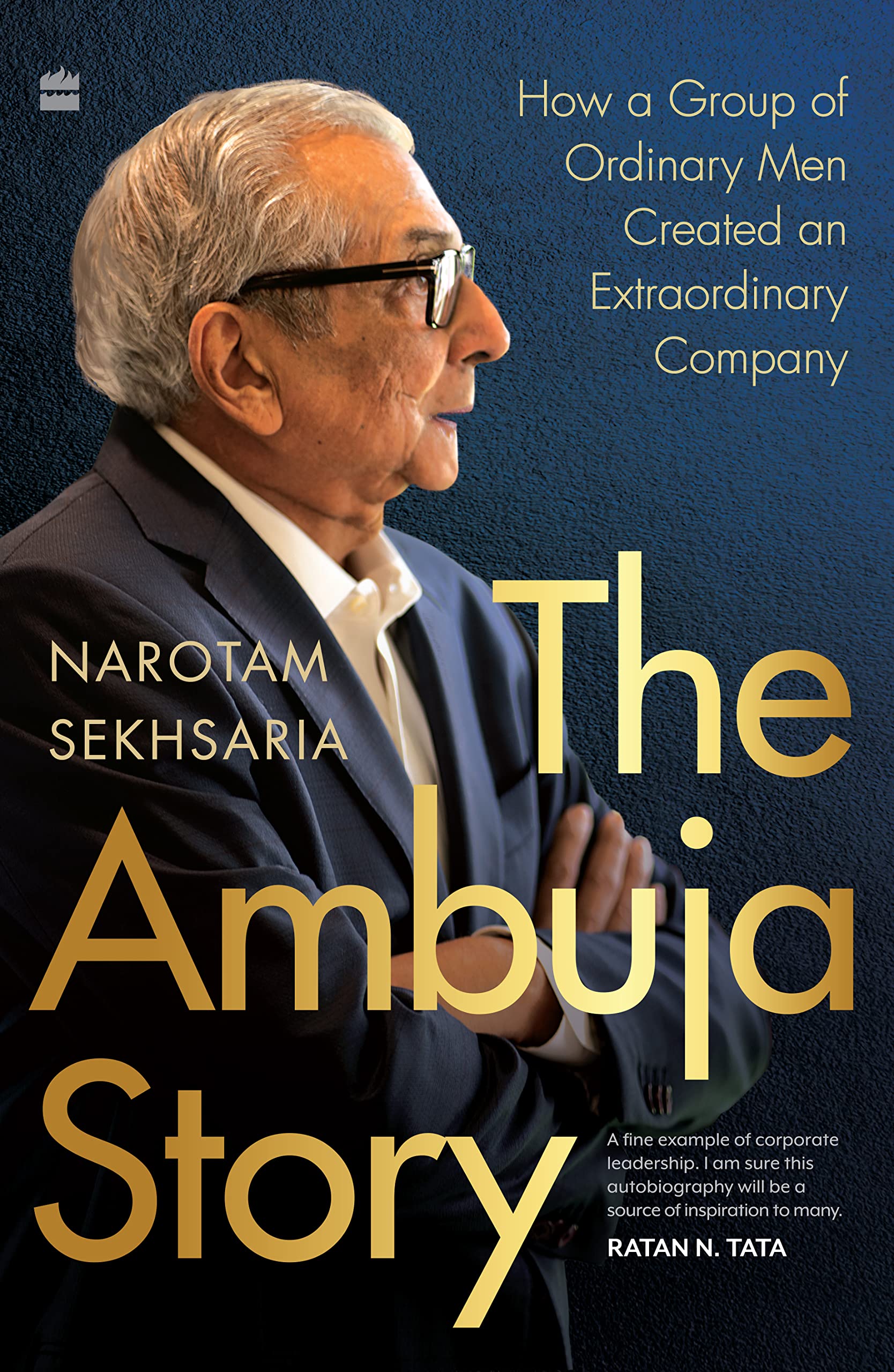
The Ambuja Story: How a Group of Ordinary Men Created an Extraordinary Company by Narotam Sekhsaria
Comments by: Pradnya S. Ganar
The other day I came across this dialogue by Amitabh Bachchan from the movie Piku. He tells his daughter, “Shaadi bura nahi hai, lekin purpose hona chahiye”. That translates to saying that there needs to be a purpose in marriage. I couldn’t have agreed more with the legend. What is marriage after all? Two people with strengths and weaknesses of their own, finding a common ground of love and respect, committing to a lifetime journey of learning from each other and growing together. Management students have a term for this - synergies.
I must admit the word synergy is quite a misused used one, in business context. For me, synergy is when two plus two equals five and not four. Not all the M&A activities that companies undertake are able to achieve this, some just to do it for the sake of irrational growth and eventually end up destroying value. On the other hand, synergies can be realised in many other cases through forward or backward integration resulting in improved efficiencies or possibly through entry into new markets or business segments.
We witnessed a very significant acquisition by Adani recently. The group led by Mr. Gautam Adani made their entry into the cement business by acquiring Holcim’s stake in ACC and Ambuja for a total consideration of USD10.5bn. This implies valuation of USD168/t of consolidated capacity, significantly higher than replacement cost of USD100/t.
To quote Confucius - ‘If one wants to define the future, they must study the past’. Mr. Narotam Sekhsaria’s autobiography “The Ambuja Story” provides a very insightful and detailed picture of the journey of Ambuja and the evolution of the Indian cement industry. I am sharing some of key highlights from the same book.
Mr. Narotam Sekhsaria's journey from being a cotton trader to an industrialist is worth admiring. Efficiency and integrity were the key values that Mr. Sekhsaria believed in his life and business. During his stint as a cotton trader, Mr. Sekhsaria after getting a hunch that cotton prices might increase, bought additional quantity for one of his client who was on vacation. The prices of cotton had indeed doubled by the time his client was back. Mr. Sekhsaria assured him that he had already bought additional cotton at lower price. The client was surprised when Mr. Sekhsaria refused to accept the additional commission and was willing to forego INR50lakhs from the rally in cotton prices. ‘I was an agent and was entitled only to my regular commission,’ writes Mr. Sekhsaria in the book.
With no prior knowledge of cement, Mr. Sekhsaria started the journey of Ambuja from a plant in Kodinar, Gujarat with the help of Gujarat Industrial Investment Corporation (GIIC). The company successfully scaled up its ordinary Portland Cement (OPC) sales in Gujarat and gained 25% market share in the state. Mr. Sekhsaria believed in being honest and fair in all dealings. One such example is the way Ambuja appointed their dealers. Traditional way was to squeeze massive cash deposit to the tune of INR20 to 30lakhs (INR2 to 3Crores in today’s value) from them for dealership. Ambuja however took a nominal payment with the only condition that the dealer would make the payment within the prescribed time.
Mr. Sekhsaria also suggested Ambuja hire twenty-five marketing representatives. These representatives would be spread all across the state of Gujarat and will be in regular touch with the dealers and stockist understanding the market requirements. He insisted they wear a tie like the pharma reps did because in India, any man with a tie or suit was respected more. Mr. Sekhsaria always challenged conventional ways of doing business and figured out ways to make it more efficient. While the typical credit cycle for the industry was 30 days, Ambuja was also able to reduce the same to 7 days. This also helped the dealer to receive early payments from their customers, which improved the cash flow in the entire system.
Fearing risk of regional concentration, Ambuja started planning their expansion in North. Himachal Pradesh, with its rich limestone reserves was an ideal choice but also a difficult one considering the topography of the place. However, ACC’s success in commissioning their Gagal plant was a reference and so despite all challenges, Ambuja’s plant was set up in the village of Darlaghat in Solan district. This was also the pre-computer era, and all the mapping and recording work had to be done on paper which made the process all the more tedious. The grinding unit for Darlaghat’s clinker was identified in Punjab. Punjab also had a problem with the disposal of fly ash, which Ambuja would utilize to manufacture Portland Pozzolana Cement (PPC).
Ambuja was known for its OPC in West and to make PPC cement a success in North, advertising had a huge role to play. The very popular Ambuja ads with Boman Irani and Great Khali today are a testimony to the efforts of the company on this front.
Despite growing ambitions, Ambuja cement was also one of the most cost efficient company and focussed on curtailing pollution even before ESG was a thing. The story behind Ambuja starting their coastal transportation operations from Gujarat to Navi Mumbai is also quite interesting and close to home! Mr. R.C. Sinha, then MD of the City and Industrial Development Corporation (CIDCO) was charged with developing the Navi Mumbai project. He had been instrumental in developing the NRI complex in Seawoods. Mr. Sekhsaria’s cordial relationship with R.C. Sinha helped Ambuja get a land for Port in Navi Mumbai and also a buyer in CIDCO for their bulk cement.
The second half of 1990s saw a wave of consolidation across the country with the abolition of licensing and dilution of the MRTP (Monopolistic and Restrictive Trade Practices). ACC acquiring Modi Cement; India Cement acquiring Visaka Cement; L&T acquiring Narmada Cement; Lafarge acquiring the cement division of Tata Steel and Raymond Ltd were some of the deals that happened.
ACC also acquired DLF’s 1.5mt unit in Rabriyawas (situated in Pali district of Rajasthan) with the help of Mr. R. V. Pandit. Mr. Pandit, an ally of Mr. Atal Bihari Vajpayee held strong swadeshi nationalistic views and approached Mr. Sekhsaria after reading about a possible takeover of DLF by Lafarge. ‘How can you let a multinational buy an Indian company?’ was his question to Mr. Sekhsaria. Post the DLF acquisition, Ambuja also bought Tata’s ~14.4% stake in ACC at INR 370 per share, which was met with a lot of criticism from the media.
In 2001, Grasim had acquired the 10.45% stake that Reliance Industries owned in L&T and had further increased its holding to 14.9% through market purchases. To ward off a hostile bid on the whole company, L&T had agreed to sell its entire 16mt capacity cement division to Grasim. [1] With market getting competitive and fearing a hostile takeover of ACC, Mr. Sekhsaria eventually approached Holcim to buy its shares in ACC. Holcim agreed to pay an EV of INR4,500 per tonne for the ACC share (20% higher than what Grasim had paid to L&T).
On the personal front, Mr. Sekhsaria was diagnosed with mouth cancer and had to undergo multiple surgeries. Keeping his health in mind, he eventually decided to sell his stake in Ambuja as well to Holcim for which Holcim agreed to pay INR9,000 per ton of EV. Mr. Sekhsaria resigned as soon as Holcim bought stake in Ambuja in 2006 and was succeeded by Mr. Singhvi.
Cut to May 2022, the Ambuja and ACC assets of ~70mt have found a new owner in the Adani group. The value and purpose this deal can serve to be a discussion for some other day.
References
[1] Page 290, ‘The Ambuja Story’ by Narotam Sekhsaria
Mutual Fund investments are subject to market risks, read all scheme related documents carefully.