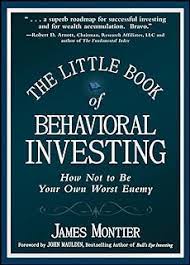
The Little Book of Behavioural Investing - by James Montier
 02-01-2019
The Little Book of Behavioural Investing - How Not to Be Your Own Worst Enemy by James Montier
Comments by Sachin Trivedi
January 2019
This about the book I read this year “The Little Book of Behavioural Investing”. I found this book interesting as this book helps me recognise some of the behavioural weakness and guides how to overcome them. It is important to acquire self-discipline and control over our emotions.
Traditional economics rests on the premise that human beings are perfectly rational creatures who act in their best interests. But in reality many of us often allow our emotions to prevail and conduct in ways that is not logical. We take decisions which are not necessarily in our best interest. Not only are we behaviourally flawed, says Montier, we compound our troubles by failing to recognise our weaknesses. The author suggests that one way we can avoid being swayed by emotions at critical junctures is to pre-commit ourselves to the rational course.
I also liked the fact that it is important to focus on process and not on outcome. As rightly pointed in the book, the management of returns is impossible and management of risk is illusory, but process is one thing we can exert an influence over. By focusing on process we maximise our potential to generate good long term returns. Not just in investing, humans have an innate tendency to over-rate their skills in most walks of life. We also attribute our successes to our skills and failures to bad luck. If we make money during a bull run, we attribute it to our talents rather than to market conditions. Puffed up with hubris, we then turn careless and buy stocks of poor quality. When the downturn comes, the values of these stocks sink, leaving us emotionally scarred. I committed a similar mistake by investment in one of the transmission company. In this particular investment, company kept adding to the order book, posted healthy operating profit but cash flows were poor, resulting in collapse in profits later on. To avoid such over-confidence, we should deliberately cultivate the habits of being critical and skeptical.
Other area this book touches is about information overload, which could be issues for many professional fund managers in today’s world. In reality more information could raise our confidence but not necessarily improve quality of decision making. Therefore to avoid this overload it is important that we create simple checklist of 5 to 10 criteria for investing in stocks. This check-list not only gives us a summary of past performance but it also helps us differentiate the narrative from execution history. Humans/Investors are also subject to confirmatory bias, wherein we look for evidence/information that confirms the idea that we already have. To overcome this bias it is important that we deliberately seek out views that are at variance with our own and then test the robustness of our views against this new found opinion.
There is no guarantee that we will become a better investor by reading about investor psychology and issues. Because lot of these psychological pitfalls, biases are hard wired in our brains due to either our genes or past circumstances. In that sense the job of avoiding these issues is tough. But good awareness and knowledge of the existence of such psychological issues is, in my opinion, a first step towards improvement.
I would recommend investors to read this book. This book is full of suggestions and real life cases of great investors regarding how one can safeguard self against some of these biases.

Sachin Trivedi is Senior Vice President and designated as Head of Research & Fund Manager, Equity at UTI AMC Ltd. He is a B.com graduate from Narsee Monjee College of Commerce, Mumbai and holds a post-graduate degree in management (MMS) from the K. J. Somaiya Institute of Management Studies & Research, Mumbai University. He also holds a CFA charter since 2004 conferred on him by the CFA Institute, USA. He began his career in June 2001, with UTI. Sachin has 16 years experience in research and portfolio management. In research he has specialized in Auto OEM, Utilities, Capital Goods and Logistics.
Other Impactful Books
Don't miss any update
Be the first to get exclusive offers, articles and news on our product directly in your inbox.